Category Archives: Uncategorized

Tokenization: How to Digitize your Offerings

Digital transformation – ever heard of it? Its a term we have heard over and over again in marketing hype. Most businesses offer their goods and services through digital means today called eCommerce. But delivery is a different matter. Physical redemption of digital orders is difficult and fraught with fraud. This is why physical coupons are still used at the supermarket. How about how coupon codes for eCommerce sites are being shared on the internet? Enterprises want the speed and ease of digital but with the control of physical. This is where tokenization comes into place.

Tokenization in a nutshell

Tokenization is where you wrap a web3 NFT around the redemption of a physical good or service. Think of it as a digital IOU. This allows businesses to sell at demand. Then “delivery” is split. The consumer gets a token to be redeemed later. Then the redemption can occur when the physical good is available. Redemption can be a simple CRM integration.

Separating sale and delivery in this way provides flexibility in the business model. This concept works on public or private blockchain. It is universally available today. The downside is trust – the consumer must trust the brand to deliver. This is what plagues the current business models of kickstarter and indiegogo. Web3 addresses that this by having authorship listed. Consumers can know if tokens are legit. Brands need to use web3 standards and legal documentation to address consumer trust.

Business Case for 100% Digital

Going fully digital means the opportunity to automate. Look at during the recent pandemic. Digital service offers like zoom skyrocketed in value. They offered a 100% digital delivered product; scaled in the cloud and sold online on-demand. The results were a great product meeting the market opportunity fully. How many sales do you lose because it took too long to get back to the customer? How many consumers give up because delivery time is too long. With tokenization, you can meet your market demand on-demand like zoom. No matter your product or service.

Why Web3? Because of Napster

As the consumer must trust the brand, you must trust the method by which you are tokenizing your value. You do not want to forget the lessons from the music industry of the 90s. Napster and mp3s created enormous pain and obstacles towards digital transformation. Without the control, you could be held liable for scammers and pirates. There is no point in creating offerings in the digital domain, if you cannot be sure you will get paid for it. Web3 has the bi-directional trust built in to ensure you control what you create.

My favorite use case: Pre-order

Preorder is something that many brands fail to take advantage of. Kickstarter and Indiegogo are popular examples of this model. Consumers can buy an idea with the promise that the brand will deliver the product once its manufactured. This sense of community and sponsorship has propelled these services to bootstrap many startups. Tesla does preorders all the time. Cybertruck orders are in their 4th year. That is a lot of consumer trust! I have talked to a major auto manufacturer. They told me that 21% of pre-orders fall through due to consumers getting impatient.

Web3 and tokenization can offer key benefits and communication to keep consumers engaged. Perks and loyalty plays can enable better revenue retention. Web3 makes this use case work better, because brands and consumers have trust in the infrastructure. I see this trust as instrumental to the success of tokenization. Just like SSL changed the game in eCommerce, Web3 will change the game in digital transformation. The question is what game do you want to change?

What Tokens Do You Want to Sell?

Tokenization is a powerful way to digitally transform your business offers. Web3 provides the trust and flexibility needed for digital transformation. You can confidently explore new business delivery models used in the marketplace today. Building tokens is easy on web3. Managing your web3 assets can be tricky. Do not be afraid to ask for help. With proper guidance and support, you can find your north star in tokenization. Hit me up on messages, I would love to hear about how tokenization can help your business.


Managing the Software Chaos: Achieving Quality Product Development Outcomes

Have you heard this before? The product development started great and we made our first milestone. BUT, ever since then things have gone off the rails.

Or how about this one? Our technical debt is unsurmountable, our only option is to depreciate. We are seeing horrible retention rates. How did things go so wrong?

Customer experience (CX) is about delight. Making the consumer of the application happy to use it and be in awe of its value to them. Novelty will only get you so far. Reality will hit your user community. Bugs will disappoint. Depreciation of keys features will enrage them. Upgrade paths that are no different then rip & replace will lose you customers. CX is about delivery of quality software. The better the software, the better the experience.

We all know what great software is. We all understanding the benchmarks. The problem is achieving those benchmarks. How do you avoid the primrose path of product development? By understanding, embracing, and enforcing sound engineering best practices.

What is Your Dream?

Let’s start at the beginning: ideation. This is where you define your vision. Who is the consumer? What is their journey? What is the market: from a price, value, and definitive profit opportunity. We live in reality, what are your acceptable trade-offs? How are you going to sell this product? What are the marketing materials required? What is the go-to-market strategy like market segment and demographics? What timelines do we have?

This will allow software creation within the constraints of the business. This means budgets, roles, responsibilities, and investment requirements. Hopefully you have heard “no bucks, no Buck Rodgers” — its as apt now as 50 years ago. This vision will allow your team to make good decisions. The vision is what creates and enables business alignment. When aligned, we can begin creating value.

Realization is Better than Building

Developing a software product is sometimes called sprinting. I see it an appropriate term. To generate business value, you will want to set a short-term goal, work on it, and measure if you made that goal. What is the release strategy? What timelines do you have, that defines the goal setting. Remember the marathon is the release. Segmented sprinting will get you there with the least amount of technical debt possible.

What is technical debt? Product Manager’s boogeyman. That is wasted productivity. When you ask to build something that provides no business value, it is a waste. If you have to re-write something in the future, it’s waste. Eliminating or minimizing technical debt is a key feature of quality software development. That is why agile development principles exists. It aligns development to the business regularly minimizing waste.

As part of agile you have planning sessions to talk about your goals and set them up. You have retrospectives to learn, grow, and adapt to challenges. You have tools that track tasks, resources, and hours. These are vital best practices that make quality software. But even bad software team have defined processes and great tools. The real difference is in the culture or in the people. Using the process to grow talent. Being accountable so you make goals. This is only possible with sound leadership and quality resources. Doing the work is about harness a team’s excellence. Maintaining that begins with quality assurance.

Software is a Business, Run it Like One

Great software is not defined by delight. Great software is a measured outcome like any other business unit should be; with SLAs and KPIs. Your vision should include your tolerances. Enterprise-grade, Commerical-grade, and Carrier-grade: there are many standards out there. What is your standard? What contract do you have with your consumer (written or otherwise)? Once you have your standards, we need to understand the different layers of missing them. What is a P1 vs P2? These thresholds will set the bar of quality of your software. They will allow you to compare individual output to team outcomes. Understanding your standards and your consumer base will enable you to create a test strategy. This is your bar. This how to define quality software.

Many organizations get held up on test automation. Automation is about helping resource management and being more efficient. This is an excellent goal for mature development. But if you first cannot test manually, then you are not ready for automation. Automation distracts many organizations from the purpose of testing – reporting. You need to know if you are making your standards so you can release. That is the most important party. Releasing software is the goal. Businesses expect releases. Testing reports, will tell the team they are ready to release. But they also provide more value. Testing results will also let you if you are resourcing correctly or “achieving velocity”. Do you have enough developers? Do your developers need more training? Who are your leaders? Do you need automation? Great software is made in the QA phase. Applying standards and data, allows software to be released on time, under budget, and with minimal defects.

Best Practices are About Managing People

Excellence in development all about applying best practices. Starting in product visioning. Applying agile development processes. Releasing with quality assurance. The trick to managing the software chaos is following best practices. This is not about the latest development tool. This is not the latest development language. This is not the latest process framework.

Software development best practices are about the people. Its about leadership having the proper data to make good decisions. Engineers focusing on excellence in delivery. You get this working, then ideas become experiences. And experiences change the world. Reach out to me if you ever need to change world, I have a team ready to help.

Understanding the Two Business Cases for GenAI

Artificial Intelligence, Real Benefits: Applying GenAI in CX | TELUS  International

#GenerativeAI is the newest hype vehicle in technology news cycle.  People are saying its going to replace 80% of jobs. They are saying that soon #LLMs will figure out how we will live forever. The hype is nonstop.  Unfortunately I live in reality.  How are people going to make or save money with Generative AI? In this I see two ways.

Driving Productivity Gains with AI

First, you can augment your existing personnel to drive faster, more productive outcomes.  The #ROI is simple.  One person with GenAI provides X value and another without provides Y.  If X is greater than 2xY, then you have a great business case. People want to say AI will replace humans. I have not seen these opportunities. This is not like the bank ATM replacing human tellers.  The business opportunity for Generative AI is more like the laptop. Having a mobile workstation for an employee means more work done by each employee. When more work can be done by an employee, this does not mean humans are losing jobs to AI.  It means that employees can have better jobs, with monotonous tasks done by the #AI.  I remember working with a large telecom provider about 5 years ago.  They had model with a singular US resource as lead and two offshore resources on that squad.  The concept was simple, its like having one employee work 24 hours a day for around the cost of 1.25 employees.  It was very successful and I see Generative AI offer similar advantages at a lower cost.

Elevate Your Consumer Experiences

Lastly, you can make it easier on your consumers to buy your products by enhancing the experience. This is my personal favorite. Growing the pie is always more fun than shrinking it.  Instacart is using Generative AI to allow embedded search into their mobile application.  Users can search for recipes. Once selected, the ingredients are added to user’s carts. This drives ease of use, increased #CX, and higher revenue.  Use cases like Instacart show the long-term value Generative AI.   Its all about increased engagement through consumer delight.

My job is about defining and delivering experiences that delight clients and consumers. Generative AI offers both ways to save money and make money.  The question is what is your use case?  Only humans can help you with that.

Why is Web3/Loyalty the New Peanut Butter/Jelly in Retail Engagement?

Everyone should know what #retail #loyalty programs are. The most common ones are a way to capture your contact information. This gives brands the ability to email you offers to buy more products. The basics are simple. You buy stuff; you get points. This allows you to get discounts or more free stuff. It makes sense logically, so that’s why it works. Both consumers and brands get frustrated with this approach, but things are changing.

Enter the concept of communal loyalty. Capturing the consumer heart, not just the brain. Personally, I see this as “fandom”. The consumer is part of the brand. They identify through their brand. My example is that I am a Miami Dolphins fan. And I live in DFW/Cowboys country. I go out of my way to find a community like me. I am doing my part. The NFL does not make this easy, so social media fills the gap. When a brand relies upon social media, they lack control of the message and lack authority to upsell. So how do you create communities, gamify them, and upsell to them like social media? Enter web3…

Web3 is a great example of technologies designed to confuse the masses. In the arena of loyalty, web3 infrastructure is like a public bulletin board. Brands are the admins, the influencers are the mods, and engagement is the goal. The difference is there is no hosting cost. You pay when you make money. Also, web3 as infrastructure is great at secure record keeping and P2P engagement. These are the backbone of communal loyalty programs. First, you will want a method to keep track of who are influencers – these are NFTs. You will also want to keep track of the value a consumer has to the brand – these are tokens. Then, you will want consumers to be able to interact anonymously – these are wallets. Web3 is the perfect infrastructure for communal loyalty strategies.

Getting started is always the most difficult challenge. Greenfields are easier. Changing traditional programs can be too difficult and may not be cost effective. My recommendation is always find your north star. Leverage your vision to crawl, walk, then run into the future. If you need a helping hand, let me and my team know. We are alway happy to help innovate with a brand.

“Do More With Less” – The Perfect Mantra for Generative AI

In my career of many technologies and industries, the most common thread was my buyer looking to “do more with less”. Greenfield projects are always more ambitious then the budget.  The brownfield projects had budgets shrinking.  The question was always how do we push a better ROI for the business?  In the past, there never was a silver bullet.  Enter Chat-GPT.  Recently the IT world has been shaken to it foundations with the addition of Generative AI.  At its core, its reasoning engine, built with a common internet knowledge.  At the speed of a clock cycle and the cost of $0.002 a task – it can do anything.  Or at least attempt it…

The drawbacks are there.  This is nascent, over hyped technology. Its accuracy is lower than machine learning and deep learning methods.  It hallucinates, or just makes up results.  The data privacy and security is also very concerning. But the opportunity is tempting to using this technology for any and all use cases. While I see plenty of danger areas, I like to think to the positives. Whats missing is clear – a harness.  You cannot expect the silver bullet, but you can lower the bar of success.  That is what Generative AI provides – “Do More With Less”.  Controlling the inputs and outcomes can be helped with simple business rules.  Off-the-shelf ML models can greatly impact the reliability of GenAI outcomes.  This is the definition of Digital Engineering.  We create predictable technology-based outcomes with unpredictable technology.

My advice to clients?  What ideas did you have to scuttle because they were too ambitious for the business dollar? What transformation project has been put on hold waiting for “a better way”. No is the time to make the impossible thing hard or the hard thing easy.  With Generative AI, the realm of possibilities have gotten larger. Reach out, I would love to hear about your “impossibilities”.

The Future of Web3 is Infrastructure for CX

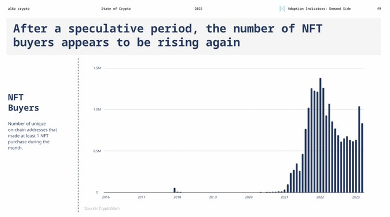
We all know, Web3 is in the the trough of disillusionment. The hype it has received over the past 3 years has died down.  The negativity around security, adoption, and governance has drowned out the believers. Ignored are reports from a16z that the digital art world has exploded in patrons and now growing again. The traditional use cases have gotten stale.  The tarnish is visible in the media.  The truth is far different from this narrative. Web3 has proven itself beyond any doubt with over 400 million transaction in 2022.  This is only one chain,  Ethereum.  This should be a call to all digital architects – web3-as-infrastructure is ready.

Digital Content Management is an area I expect to be the next explosion.  Imagine you are a Youtuber (I have one in the family).  You have a community of 100K or more followers.  What is more lucrative?  Selling physical merch or digital? Patreon is a great tool for the creator economy for this reason.  You can setup a quasi-loyalty, charge subscription and deliver digital rewards.  How about Kickstarter?  Sell the goods before you make them.  Both of these models are availability simultaneously with web3 as infrastructure.  The question is who is going to provide it?  Another web2 company or brands themselves?   Why rely upon social media when you have the products and followers?

With the built-in security and public trust models, creators (individually or corporate) can harness their ideas quicker to market. The idea-to-revenue latency should make anyone interested in the opportunity of web3.  Creating a value chain pipeline with web3 is easier than ever.  There are even competing chains you can partner with.  Ethereum, Solana, and Polygon are only three of your choices.  Your ability to digitize your product line is limited soley by your imagination and community.  New tools and services are being introduced to reduce your challenges and consumer friction.  So what is the hold up?

The first common problem is in adoption.  The barriers to entry have been too great for most demographics — to date.  This is fortunately changing. New tools, technology, and methodologies are available to streamline and secure web3’s front door.  Trusted, hosted, and managed wallet solutions are available.  They allow both corporate and consumers the opportunity of access without the complexity.  With a trusted front door, outcomes with web3 as infrastructure will skyrocket.

The biggest challenge with a brand experience is with governance. Web3 was designed as a B2C experience.  Every account, or wallet, would need to be individually held.  Corporations are not individuals.  Having a flexible governance model that allows corporations to create, store, sell, and track is an absolute necessity.  Brands need to know they can control their outcomes.  Things will change once brands have equal or greater control over  digital goods.  Again, innovation has occurred.   The tools are available to manage corporate digital assets successfully.    With proper governance in place, brands will see the outcomes to the digital strategy not just “investments”.

If you are looking to increase security and reduce the cost & friction of your B2C experiences, reach out.  My team and I are helping dozens of our clients leveraging web3 to provide full ROI experiences.  The promise of web3 goes beyond the cryptocurrency and digital art use cases.  At Catalyst, we help clients harness its power with the business ROI required to build the future of CX.

How to be a thought leader…

Entrepreneurs as Thought Leaders - Reputation Today

“Tell me how to do my job” is a sentence I have never heard in consulting.    Unfortunately that is what most people believe is thought leadership.    Crudely, people think being a thought leader is about predicting the future.   I have never owned a crystal ball.    So, ok please define thought leadership?   I was recently ask this question by a peer and it made me think.   I figured it would be good to list out my thoughts in the hope it helps others in the industry.

A Leader's Psychology | Reality quotes, Boss vs leader, Inspirational quotes

Not much difference between this boss vs leader and tech bigot vs thought leader

Let’s start a cult

I tell people that being a thought leader is like starting a cult.   You see the value, not the technology.   You see the delight, not the terminology.   You are passionate about the possibilities.   You are excited by the future, you have a vision, and you are looking to make an impact.   Once you are here, you are just starting your journey.   Just because you have thoughts does not mean you should lead.

Next up are the challenges — what you should think as opportunities.   These are the “whys”.   They provide context and allow you to understand how the world works (or doesn’t).    Being a thought leader is about helping and fomenting change.   I call it impact.   Impact is scary, risky, and costly.   All things most people want to avoid.   Thought leaders embrace this and help people focus on the destination – value.    If you cannot find, illustrate, and quantify value; then you cannot be a thought leader.

Thought leadership cannot exist without people – clients, partners, peers, or employees.    People are looking for help.   Successful leadership is about support, education, and alignment – not decision making.   If you want to be a decision maker, be an executive.  If you have no desire to communicate, collaborate, listen, learn, and interact, then don’t bother being a thought leader.

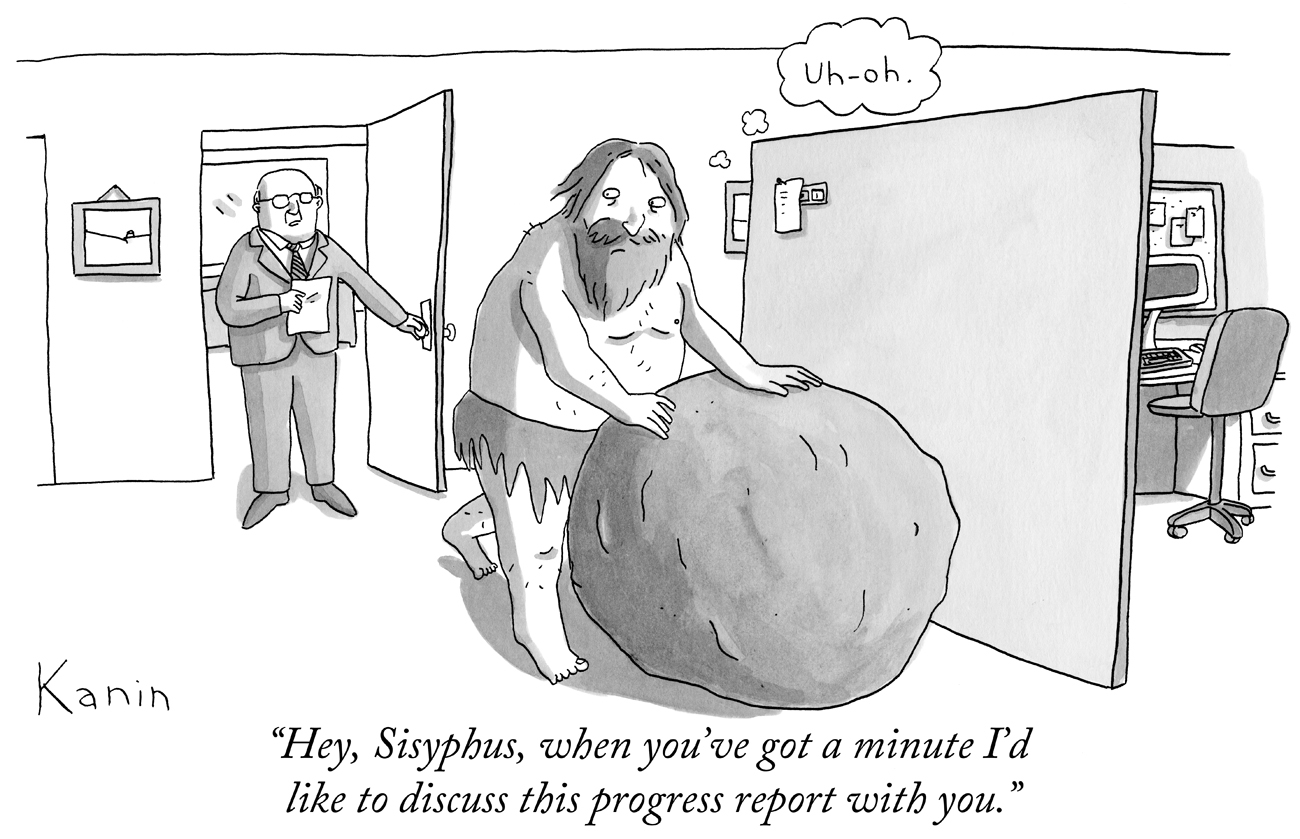
Thinking about Sisyphus (Or, the Afterlife with Some Rock 'n' Roll) | Getty  Iris

Being a Thought Leader

Being a technology sherpa isn’t luxurious or glamorous. It means facing everyone’s doubt every day. Recruiting is an every meeting exercise. Week-to-week, the herding of cats is a grind. You spend more time trying to understand other people’s perspectives then your own. You are a thought leader when people come to you about things you have no idea about and they say: “What do you think?”. When people you have hired, leave you for a higher paying job and say “thanks for inspiring me”. You will know when you are a thought leader when you see the impact. You will see the change to the business, to bottom-line, but more importantly to the people.

In writing this blog and sharing it with my friends I was asked a simple question.  What is the difference between founder, visionary, or thought leader?   My simple answer: the outcome.   Thought leader doesn’t mean you are correct.   Visionaries may never have followers.   Founders may not forward looking.   What a wonderful world of confusing terms 🙂

Reach out to me on @Shawn_Ennis, I love the chat more about thought leadership.

Latest Video: Revolution Your Approach to CX Through Web3

Web3 use cases

Below is the link to my latest interview at Concentrix surrounding Web3, Web3.0, and how business can think differently about this technology.    Business value should be the first concern of any technology.   With how confusing the blockchain industry is, enterprises will do well to hire an interpreter.    Reach out to me today if you have want to know what blockchain can do for you and your company.

https://www.concentrix.com/insights/videos/revolutionize-your-approach-to-cx-through-web3/

The Beginning of the Enterprise AI Arms Race

Most days digital engineers and architects feel like cloud-centric wrench turners. Thought leaders have talked about new ways to solve common problems. The world is changing as unsolvable problems are being addressed by AI. I do not want to harp on using AI to solve age-old mathematic problems. Or that Telsa is using computer vision to automate driving. All these are noble goals, but they are on the margins – net new impacts to enterprise and business. Fun and lovable, AI has been seen as a cheat code for engineering. The perfect shortcut. But now things are different. Now generative AI is showing us that it can disrupt business services.
 
Technology services like ChatGPT are different sorts of AI. First, it is contextual. You can treat it like a human and tell it things to remember, then ask it to do something. It’s historic; in that, it has decades of content to leverage so it can answer your request. Lastly, it’s in real-time. You can interact as if it’s a person. You do not HAVE to understand how to interface with it. You can create 10-page white papers explaining your rationale on how you solve business problems. I know this because I use it that way.
 
The disruptive quality of the technology is fascinating. “Binary” level content creators as far apart as technology coders and legal copyrights — will all need to learn a new way how to do their jobs. Technology can rarely change the level of effort at two orders of magnitude – but here we are. Another area I am seeing disruption is with artists. Great experiences are created via iteration – explore, editorialize, repeat. Generative AI offers a method to go on any flight of fantasy, generate an outcome, and see the results in minutes. Tons of other industries will be disrupted. Compared to the ATM banking machine, this should be a bigger and more widespread impact.
 
Many challenges lie ahead. The technology is already being politicized and taken out of context. The ethical use of generative AI would require it to be used in a sidecar fashion first. The answers you get from your queries sound confident, but the accuracy does not align with that confidence. My top recommendation is to always remember the value you get out of the technology. This is what matters – what force multiple are you looking at? If you cannot save 50x time from a radical change, keep looking for value.
 
That all being said. OpenAI got my $20/month. This technology helps me efficiently convey my value. As a businessman thought leader, technologist, and executive it increases my value. I hope to get my money’s worth. Leave a comment or reach out to me on my Twitter DMs, I would love to hear about your generative AI journeys.

High ROI IoT and Edge Solutions for Sustainability

Earlier this year, a Gartner® report mentioned: “Previously, most enterprises viewed sustainability as a reputational overlay, which affected mostly marketing and communications. Nowadays, a growing number of companies see sustainability as a strategic parameter that directly affects how they do business and run their operations.”[1] Why? Because it’s a money maker. A well-crafted corporate environmental sustainability practice increases sales, investment, brand equity, and profitability.

Here are some of the ways that the IoT and Edge team at Concentrix Catalyst helps companies meet their sustainability and financial goals:  

We find that many are surprised to learn that edge solutions for sustainability are also affordable and easy to implement. Here’s additional detail on each:

Agriculture

In a traditional farm setting, the farmer needs to physically be in the field each day to monitor the equipment, assess its condition, and take readings. With equipment manufactured by a variety of vendors, farmers must learn to use multiple software tools to configure each piece of equipment. In addition, there is an industry-wide underutilization of scientific data for effective farming; for example, many irrigation systems continue to sprinkle water, even when it’s raining. An increasing number of farmers are turning to precision control and monitoring capabilities that allow them to manage their business more efficiently—freeing up time and money for other undertakings in an industry with notoriously small profit margins. Concentrix Catalyst developed central mobile-enabled application able to monitor, control, and manage operations across the farm, freeing the farmers from the need to physically assess conditions and control equipment on their farms. The solution enables farmers to monitor soil moisture and manage ancillary tools, sensors, and devices, regardless of manufacturer. A farmer can access the system, which helps utilize critical resources effectively by calculating scientific data, via desktop or a mobile app.

Streaming audio and video with a command-based interface allows her to view field conditions in real-time and respond accordingly.

Hospitality

A well-known worldwide fast-food franchise needed to reduce waste. Kitchen equipment was prematurely ending up in landfills due to accidental, but irreparable, damage by untrained operators. Food, like fryer oil, was being wasted due to the inefficiency of kitchen technology and employee practices. The restaurant chain hired Concentrix Catalyst to analyze kitchen operations using edge and Internet of Things (IoT) technology. We used edge and IoT to collect and analyze data on kitchen equipment and kitchen staff protocols, resulting in optimization recommendations for over 45,000 restaurants globally.

Google Coral is a leader in edge computing solutions like this, as Coral devices are affordable and the platform processes data very quickly.

Real Estate

Heating, ventilation, and air-conditioning (HVAC) systems in medium and large industrial and office buildings ensure safe, healthy, and comfortable conditions for occupants. A large office park or university campus can consist of hundreds, or thousands, of HVAC units. Industry estimates purport that these systems account for 35 percent of and 40 percent of commercial building energy consumption worldwide. Accordingly, maximizing the efficiency of these systems can result in considerable savings for an organization.

To leverage IoT and edge solutions for sustainability, Concentrix helped a specialty manufacturer of industrial application control valves design precision control of commercial heating and air conditioning systems. They wanted to help organizations better manage costs related to commercial heating and air conditioning control systems. Statistical analysis of data collected via climate-control systems and existing building automation systems affords the opportunity to control the climate of a building or group of buildings more precisely. It also reduces the resources needed for troubleshooting and addressing problems with the HVAC system due to central control of the systems and the ability to better pinpoint issues with the system.

We helped create a streamlined data pipeline that allowed the client to collect the information required, display the correct information to the clients who owned the data, and give engineers access to devices from a central location. A web app allowed for access to the precision-control system, and Catalyst designed the embedded system’s software for control and optimization of sensors and control valves—the software layer, or interface, with which the client’s customers and technicians interacted.

The end solution included an extensive feature set that allowed multiple consumers to benefit. C-level executives could view information about the building at the campus or building level to ascertain where money was being spent on energy use. Because the solution worked with existing building-operation systems, building operators could log into the app to better control building climates, choosing when to override the existing automated controls and responding to occupant comfort. A field engineer suite allowed technicians to monitor, analyze, and update the control system, and enabled remote management and firmware updates for the system hardware—reducing the time and resources needed to send engineers out to examine individual connections for problems.

Good for business. Good for the planet.

Sustainability and profitably are not mutually exclusive, and both are necessary to compete in the modern market. Companies that carefully plan their sustainability strategy and leverage technologies, like IoT and Edge, realize meaningful improvements in sustainability while also improving margins.

For more information about edge solutions for sustainability, and how our Sustainable Experience Engineering (SEE) practice can help your organization with its corporate environmental sustainability efforts, please contact us.


[1] Gartner, Competitive Landscape: Sustainability Consulting,., January 18, 2022

GARTNER is a registered trademark and service mark of Gartner, Inc. and/or its affiliates in the U.S. and internationally and is used herein with permission. All rights reserved.