Category Archives: Uncategorized

Architecting the Moat: Creating Your Innovation Playbook

The Defensibility Crisis

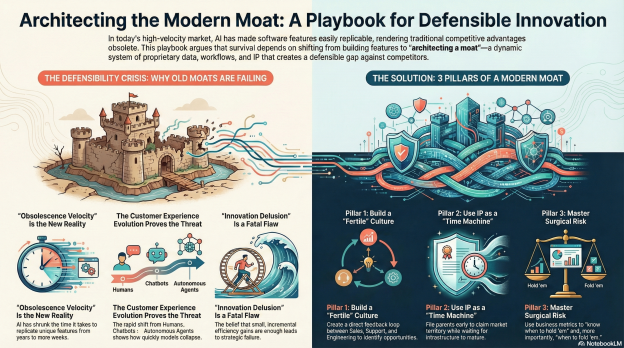
In 2026, the traditional concept of a “sustainable competitive advantage” has been disrupted by Obsolescence Velocity. For the CIO and CTO, the challenge is no longer just “digital transformation”—it is the navigation of a landscape where the transition from Humans to Chatbots to Autonomous Agents occurred in less than 24 months.

This whitepaper argues that in a world of “Commodity AI,” features are no longer defensible. To survive, organizations must shift their focus from building functional software to Architecting Moats. A technology-based moat is not a static barrier; it is a dynamic system of proprietary data, agentic workflows, and strategic intellectual property that creates a widening gap between your business and the “low-cost” commodity players.

The Core Thesis: Innovation as Capital Defense

Most Fortune 500 companies suffer from Innovation Delusion—the belief that sustaining 5% year-over-year efficiency is enough. It is not. As seen in the Customer Experience (CX) sector, the demand for help is inexhaustible, but the tolerance for high-cost, high-latency human intervention is evaporating. Leaders who ignore the shift to agentic scale aren’t just losing margin; they are losing their “Right to Win.”

The Roadmap to Defensibility

To build a sustainable moat, leadership must master three critical domains:

  1. Cultural Fertility: Building a feedback loop between Sales, Support, and Engineering that identifies “ripe” areas for disruption before they become common knowledge.
  2. Strategic IP Utilization: Using patents as a “Time Machine” to claim market territory while waiting for the infrastructure to mature.
  3. Surgical Risk Management: Adopting the “Kenny Rogers Rule”—leveraging business metrics to know precisely when to “hold” a winning innovation and, more importantly, when to “fold” a decaying legacy moat.

The goal of this playbook is to move the IT organization from a maintenance mindset to an Architectural Mindset. By treating technology as a “cheat code” for market differentiation, the modern CTO can turn innovation from an unpredictable expense into a repeatable shield against competition.

Innovation is no longer just a department; it is the promise you make to your customers that their investment today is a bridge to their future.

The Anatomy of a Modern Moat

In the traditional business world, a moat was defined by geography, massive capital expenditures, or regulatory capture. In the IT-driven economy of 2026, those moats have evaporated. For a CIO, the only defensible barrier is one built on Architectural Superiority and Proprietary Intelligence.

The Moat Decay Principle

The first truth a CTO must accept is that technology moats are subject to rapid erosion. A breakthrough feature today is a standard toggle-switch tomorrow.

  • The Half-Life of Code: As AI-augmented coding and open-source models accelerate, the time it takes for a competitor to replicate your “unique” feature has shrunk from years to weeks.
  • The Dredging Requirement: To maintain a moat, you must “dredge” it. This means systematically replacing aging infrastructure—even if it still “works”—to make room for more efficient, agent-driven architectures.

The CX Evolution: A Case Study in Disruption

The Customer Experience (CX) world serves as the ultimate “canary in the coal mine.” We have witnessed a 24-month collapse of the legacy service model that provides a blueprint for every other industry.

  • The Inexhaustible Demand: Customer expectations for instant, accurate resolution are infinite. Human-linear models (scaling by adding heads) cannot keep pace with this demand curve.
  • The Collapse of the Middle: * Phase 1 (Human-Centric): High empathy, high cost, low scalability.
    • Phase 2 (Chatbots): High scalability, low cost, but low utility/high frustration.
    • Phase 3 (Agentic Workflows): High utility, autonomous execution, and near-zero marginal cost.

Companies that stayed in Phase 1 or 2 found their moats filled with sand overnight. The leaders—the “Architects”—leapt to Phase 3, building systems where the AI doesn’t just “talk” to the customer; it has the agency to execute transactions, refund orders, and predict churn.

The Catch-Up Strategy: Leapfrogging the Legacy

The most encouraging news for the “disrupted” is that Obsolescence Velocity works both ways. If you are behind, you do not need to follow the competitor’s path through Phase 2.

The Strategy: By adopting the frameworks discussed later in this paper, a late-mover can skip the “Chatbot” era entirely and move directly to Agentic Moats. This is the “Innovation Cheat Code”: using a competitor’s legacy commitment to Phase 2 tech against them.

Defining the “Hard to Replicate”

For a moat to be sustainable in 2026, it must be built on three pillars:

  1. Data Gravity: Your system becomes more valuable the more data it consumes, making it harder for a customer to leave.
  2. Integrated Agency: Your AI agents are so deeply embedded in the customer’s stack that replacing you requires a complete “organ transplant” of their operations.
  3. Unit Economic Dominance: You have optimized your “Cost per Outcome” to a level that a competitor cannot match without a total architectural rebuild.

Cultural Architecture—Building the Fertile Ground

Technology does not innovate itself. While a CTO provides the vision, the raw material for a moat comes from the edges of the organization. In the Fortune 500 world, the greatest threat to a moat isn’t a lack of talent; it is Institutional Siloing. To build a sustainable innovation engine, you must move from a “Command and Control” structure to a “Fertile Ground” model.

The Fortune 500 Delusion: Why Big Tech Stagnates

The “Delusion” is the belief that innovation can be scheduled, budgeted, and managed by a committee. This leads to several fatal flaws:

  • The Filter Bubble: As information moves up the chain, risks are minimized and failures are polished. By the time a report reaches the CIO, the “truth” of a project’s viability has been scrubbed away.
  • Success Theater: Teams prioritize hitting KPIs that “look good” on a slide deck but fail to move the business metrics that actually deepen the moat.
  • Risk Aversion as a Default: In large corps, the penalty for a failed innovation project is often higher than the reward for a successful one. This creates a culture of “Safe Mediocrity.”

The Feedback Triangle: Sales, Support, and Tech

To break the delusion, the CTO must architect a Cross-Functional Sensory Organ. True product innovation happens at the intersection of three distinct perspectives:

  1. Sales (The Market Radar): Sales teams hear the “I wish it did X” or “Competitor Y just showed us Z.” They identify where the market is moving and what customers are willing to pay for.
  2. Support (The Friction Point): Support teams know where the current product is failing. They are the first to see the “inexhaustible demand” for rudimentary help that signals a ripe area for agentic automation.
  3. Engineering/Delivery (The Art of the Possible): Only the technical team knows if a “Sales Wish” or a “Support Pain” can be solved via a proprietary architectural shift or a new AI model.

Identifying and Empowering “Smart Innovators”

Sustainable innovation requires a specific archetype: the Full-Stack Thinker. These are individuals who understand the code, but more importantly, understand the Unit Economics of the business.

  • The Mission: Empower these individuals to bridge the gap. They should have the authority to pull data from Support and vet it against the capabilities of the Engineering team without three layers of management approval.
  • The Art of the Possible: Innovation isn’t just about solving existing problems; it’s about showing the business what it didn’t know was possible. This requires an environment of open, radical candor where a junior developer can challenge a legacy process.

The “Honesty Audit”

To maintain the fertile ground, the CTO must implement a regular Honesty Audit. This isn’t a performance review; it’s an architectural review.

  • Question 1: What is the “elephant in the room” regarding our current technology stack?
  • Question 2: Which of our “unique” features has become a commodity in the last six months?
  • Question 3: If we were a stealth startup today, which part of our business would we attack first?

The Leadership Takeaway: Your culture is your primary excavation tool. If your teams cannot communicate honestly about where the moat is drying up, they will never be able to dig it deeper.

The Leadership of Investment—Timing, Stealth, and the IP Shield

Deciding where, when, and how to allocate capital is the ultimate test of technology leadership. In the high-velocity environment of 2026, a CTO’s investment strategy must be as precise as a surgeon’s scalpel. You are not just competing against known rivals; you are competing against the “Stealth Startup”—a lean, AI-native entity that can build in weeks what took you years.

The Goldilocks Zone: Mastering the Timing Curve

Investment is a game of timing. Moving too early or too late can be equally fatal to your enterprise value.

  • The Early Mover Penalty: Investing too early means you are paying to educate the market. You risk exhausting your R&D budget on a “Beta” world that isn’t ready for your “Alpha” solution.
  • The Late Mover Trap: Investing too late means you are entering a “Red Ocean.” You are fighting for price-sensitive customers in a market where the moat has already been claimed by a faster architect.
  • The Goldilocks Zone: This is the inflection point where technology capability meets market readiness. Identifying this requires the “Radar” mentioned in Section 2—listening to Sales and Support to hear when the “pain” outweighs the “friction” of adopting a new solution.

The Patent as a “Time Machine”

In modern SaaS and Agentic development, speed is often cited as the only moat. This is a mistake. Intellectual Property (IP) is your “Strategic Shield.”

  • Claiming Territory: Filing patents early on core methodologies—particularly around proprietary data handling or unique agentic logic—allows you to “freeze” the competitive landscape.
  • Strategic Patience: A strong IP portfolio allows you to play both sides of the timing curve. You can claim a patent while the market is immature (early), then wait for infrastructure costs to drop or adoption to rise before committing full capital (the “wait-and-strike” move).
  • Cost Control: Robust IP makes innovation “cheaper” over the long term because it prevents costly legal battles and blocks competitors from using your own R&D against you.

Countering the Stealth Startup

Your competitors are smart, but stealth startups are desperate—and desperation breeds speed. A CTO must maintain a “Competitive Radar” that looks beyond the usual suspects.

  • Identify the “Good Enough” Threat: Often, a startup won’t beat you with a better product; they will beat you with a “good enough” product that operates at 1/10th of your cost-basis.
  • Acquisition as R&D: Sometimes the best investment is not building the moat, but buying the team that already started digging it.

Data-Driven Capital Allocation

True leadership in innovation exists in the ability to say “No” to 90% of good ideas to say “Yes” to the 10% that create a moat.

The Decision Framework: Before a single dollar is committed, ask:

  1. Does this create high switching costs?
  2. Does this lower our marginal cost of delivery (The Agentic Shift)?
  3. Can we defend this via IP or Data Gravity?

Surgical Risk and the Velocity of Value

In the legacy corporate model, “Risk” was something to be mitigated through layers of governance and lengthy steering committee meetings. In the agentic era of 2026, the greatest risk is stagnant capital. To build a moat, the CTO must shift the organization’s comfort level from “Avoidance” to “Surgical Precision.” This section defines how to execute with agility without gambling the enterprise.

The 6-Week “Time-to-Metric” (TTM) Standard

Innovation loses its potency when it is dragged through a two-year roadmap. For a moat to be defensible, the delivery of value must be rapid and iterative.

  • Code is Disposable; Metrics are Permanent: The value of a first prototype is rarely in the quality of the script or the elegance of the UI. It is in the Business Metric it moves.
  • The Norm of Weeks: If a team cannot build a prototype that proves (or disproves) a business hypothesis in 6 weeks, the scope is too broad. High velocity allows you to fail small and fast, preserving your “dry powder” for the ideas that actually show traction.

Surgical Risk: The Sidecar Strategy

You do not need to risk the core ERP or the primary revenue engine to innovate.

  • The “Sidecar” Architecture: Build your innovation on the periphery. Use APIs to pull data from the core, but run your agentic experiments in a sandbox. This allows for high-velocity failure without systemic risk.
  • Asymmetric Upside: You are looking for projects where the cost of failure is a few weeks of payroll, but the upside is a fundamental shift in your unit economics.

The “Kenny Rogers” Rule: Knowing When to Fold

True leadership is not just about starting projects; it is about the disciplined termination of them. As the song goes, you have to “know when to hold ’em, know when to fold ’em.”

  • Knowing When to Hold: When a prototype shows a “Delta” in business metrics (e.g., a 40% reduction in support ticket latency or a 15% increase in upsell conversion), you stop experimenting and start expanding rapidly. This is where you dig the moat deep.
  • Knowing When to Fold: If the data shows the market has moved, the technology is too brittle, or the “commodity” version of your idea has just been released for free by a competitor—walk away.
  • The Data-Driven Pivot: Walking away from a project isn’t a failure of leadership; it is a successful reallocation of capital. Using real-time metrics to “kill your darlings” prevents the “Sunk Cost Fallacy” that routinely traps Fortune 500 companies.

From Prototype to Industrial Scale

Once a prototype proves the business metric, the goal shifts from Agility to Solidity.

  1. Phase 1: Prove the Metric. (Weeks 1-6)
  2. Phase 2: Harden the Architecture. (Months 2-3)
  3. Phase 3: Scale the Moat. (Month 4+)

By the time your competitors realize you’ve found a new source of value, you should already be in Phase 3, hardening the architecture and filing the IP discussed in Section 3.

The Execution Mantra: Set the expected metrics at the idea phase, prove them in the delivery, then expand before the market can react.

The Innovation Promise

Innovation is not a department, a budget line item, or a specialized lab. In the high-stakes environment of 2026, innovation is a mindset—a fundamental awareness that your business is a living organism that revolves around the technology of the day. For the CIO and CTO, this realization is the ultimate “Unlock.”

The Strategic Cheat Code

When you successfully architect a moat, you provide your organization with a “cheat code” for the market. It allows your marketing team to lead with a unique value proposition that isn’t just a slogan, but a technical reality. It allows your sales team to enter negotiations knowing that your competitors physically cannot match your delivery speed or your unit economics.

The Shield and the Promise

Technology innovation serves two distinct, vital roles for the modern enterprise:

  • The Shield: It is your primary defense against the “Stealth Startup” and the global disruptor. A well-maintained moat makes you a moving target, ensuring that by the time a competitor replicates your last move, you have already migrated to the next agentic frontier.
  • The Promise: Most importantly, innovation is the promise you make to your customers. It tells them that the money they pay for your products today is not just for a static service, but an investment in their own future-proofing. It signals that your roadmap is aligned with their survival.

The Call to Architectural Leadership

The transition from Humans to Chatbots to Agents has proven that the “standard” can change overnight. No matter how far behind you may feel, the frameworks of cultural fertility, strategic IP, and surgical risk-taking allow you to leapfrog the legacy debt of your competitors.

Sustainable innovation is the act of deciding that you will not be a victim of change, but the architect of it. As you move forward from this playbook, remember: You aren’t just managing systems; you are architecting the fortress that will define your company’s relevance for the next decade.

The moat is waiting to be dug. It is time to start.

🚀 Achieving Technology Escape Velocity: From Technical Debt to Technical Wealth

Achieving Technology Escape Velocity with AI

A Strategic Guide for CIOs to Convert Technical Debt into Technical Wealth

The Gravity of the Status Quo

In the relentless physics of the 2026 enterprise, the primary inhibitor of corporate growth is no longer a lack of capital or a scarcity of ideas—it is Infrastructure Gravity.

For decades, the IT organization has been treated like an ancestral home where new wings are added every few years without ever inspecting the foundation. Today, that foundation is crumbling under the weight of “patch-and-pray” legacy management. Most CIOs find themselves trapped in a crippling paradox: they are being pressured by the board to launch AI-powered rockets, yet their feet are cemented to a 20-year-old mainframe and a fragmented, “spaghetti” architecture.

This is the Status Quo Trap. In this state, every dollar spent on innovation is diluted by the “Interest” you are paying on your technical debt. We see it in every sector—organizations where 80% of the budget is consumed just to keep the lights on, leaving only 20% to fight for the future.

To achieve Technology Escape Velocity, you must generate enough “thrust”—measured in efficiency, resilience, and speed—to break free from the gravitational pull of your legacy environment. This requires a fundamental shift in how we define the value of IT.

Technical Debt is a high-interest, predatory loan that makes you a slave to the past. Technical Wealth is an appreciating asset that makes you the architect of the future.

Wealth isn’t just about having the latest tools; it is about Consumable Change. If your modernization efforts are so complex that your people cannot absorb them, you aren’t building wealth; you’re just moving the debt to a different ledger. True Escape Velocity happens when you simplify the core so radically that your organization can pivot as fast as the AI models it seeks to deploy.

The Infrastructure Archaeology Problem

In 2026, most IT environments are not “designed” in the modern sense; they are accumulated. We call this Infrastructure Archaeology.

When you peel back the layers of a typical Tier-1 enterprise stack, you aren’t looking at a cohesive strategy; you’re looking at a physical record of the last thirty years of tech trends. You have the 1990s-era mainframe core handling transactions, the 2000s-era “monolithic” Java middleware, the 2010s “lift-and-shift” cloud instances, and now, a chaotic 2020s layer of disconnected AI pilots.

The Complexity Tax

This fragmentation creates a Complexity Tax—a hidden, compounding interest rate on every new initiative. Because these systems were never built to talk to one another, every “innovation” requires a monumental effort in manual data movement, custom API “duct tape,” and brittle integrations.

Recent research indicates that by 2026, 65% of organizations find their AI environments too complex to manage. The result? Over half of all AI initiatives are either delayed or canceled—not because the AI models failed, but because the “data layer” underneath them was an unnavigable labyrinth.

The Firefighter’s Dilemma

This “Archaeological” state traps your team in a permanent state of Firefighting. When your infrastructure is a patchwork of disconnected silos, visibility is fragmented. When a failure occurs, the root cause could be anywhere in thirty years of code.

  • Alert Fatigue: Teams are inundated with thousands of signals across dozens of siloed monitoring tools, making it impossible to distinguish a “glitch” from a “catastrophe.”
  • Talent Attrition: Your top-tier engineers didn’t sign up to be digital janitors. When they spend 80% of their time patching “black box” legacy systems they didn’t build, they burn out or leave for AI-native competitors.
  • The Innovation Ceiling: Complexity creates a hard ceiling on velocity. If you are spending your entire budget on “staying alive,” you have zero fuel left to “speed the plow.”

To achieve Escape Velocity, you must stop being an archaeologist and start being a deconstructionist. You cannot build a 2026 business on a 1996 foundation.

The AI Unlock – A New Physics for IT

The emergence of Agentic AI has fundamentally changed the “physics” of IT modernization. Historically, refactoring legacy code was a linear, manual process that scaled only with the addition of specialized (and expensive) human labor. In 2026, we have moved into the era of Autonomous Re-engineering, where AI agents act as digital architects rather than simple autocomplete tools.

From “Copilot” to “Agent”

While 2024 was defined by “AI Copilots” that assisted developers with snippets of code, 2026 is defined by Agents that take ownership of end-to-end modernization workflows. These agents don’t just suggest a line of code; they perceive the entire system, plan a multi-step migration, act across diverse tools, and learn from the results.

  • Deep Reasoning and Dependency Mapping: AI agents can “ingest” a million lines of legacy COBOL or Java and, within hours, produce a lossless semantic map of the business logic. They identify the “logic bombs” and hidden dependencies that have terrified human developers for decades.
  • Surgical Refactoring: Instead of a risky “rip and replace,” AI allows for surgical precision. It can break a 30-year-old monolith into cloud-native microservices while automatically rewriting algorithms to be “Green”—optimizing for CPU cycles and memory usage to lower cloud bills by 15–25%.

The Universal Safety Net

The primary reason modernization roadmaps stall is fear. Fear of the “Unknown-Unknowns”—the one line of undocumented code that, if changed, brings down the entire global supply chain. AI provides the first-ever “Universal Safety Net” to neutralize this fear:

  • Automated Test Generation: AI agents can analyze a legacy module and automatically generate comprehensive unit and regression tests with 90%+ accuracy. This creates a “gold standard” for system behavior before a single line of code is modernized.
  • Simulated Migrations: Before deploying to production, AI agents can run thousands of “What-If” scenarios in a digital twin of your infrastructure, identifying potential bottlenecks or security vulnerabilities in a sandbox environment.

Acceleration: Months, Not Years

By leveraging agentic workflows, the timeline for a legacy turnaround is no longer measured in years. Enterprises are now completing full-scale system modernizations 30–50% faster and at 30% lower costs. This acceleration is the “rocket fuel” required to reach escape velocity. It allows you to shift your budget from “maintaining the past” to “building the future” in a single fiscal cycle.

Empowering the Human Navigator

Modernization in 2026 is no longer a purely technical hurdle; it is a human-centered orchestration. To achieve Technology Escape Velocity, the crew must be ready to fly a different kind of ship. The most common point of failure in IT turnarounds today is not the code—it is the Consumption Gap: the distance between the speed of technology and the ability of your people to absorb it.

The Great Re-Promotion: From Builder to Orchestrator

In the legacy era, a developer’s value was tied to their ability to write syntax and manage procedural control. In the Agentic era, every engineer has effectively been “re-promoted” to a manager. They are no longer just authors of logic; they are AI Development Orchestrators.

  • The Auditor Mindset: Training has shifted from “How to Code” to “How to Audit.” Your senior engineers now act as “Editors-in-Chief,” presiding over high-volume code outputs generated by AI agents to ensure architectural integrity and security.
  • Mastery of Intent: The new core competency is Prompt and Context Engineering. Success is measured by an engineer’s ability to describe complex business logic in natural language or declarative specs that an AI agent can translate into high-performance, cloud-native modules.

The Cultural Safety Net: Consumable Change

Resistance to AI adoption is rarely about laziness; it is almost always about fear of replacement or fear of the unknown. For change to be “consumable,” leaders must bridge the gap between “Industrial Age” operations and “Agentic Age” possibilities.

  • Killing the Firefighting Cycle: Buy-in occurs when employees see that AI is not coming for their job—it is coming for the parts of their job they hate. By delegating “digital janitorial work” (patching, documentation, T1 tickets) to agents, you release human potential for high-value strategic work.
  • The “Safety to Fail” Sandbox: Forward-thinking CIOs are building Modernization Academies. These aren’t just training rooms; they are sandboxes where legacy engineers can use AI agents to “break” copies of old systems, learning how to steer the AI without risk to production.

Systems Thinking vs. Task Thinking

The 2026 workforce must unlearn “Task Thinking”—the focus on closing an individual ticket—and embrace Systems Thinking. This is the ability to see how autonomous agents, legacy databases, and human oversight connect to form an adaptive network.

“The most successful engineers won’t just write code; they’ll architect solutions and leverage AI as a collaborator rather than a competitor. This isn’t about augmentation; it’s about the reinvention of engineering excellence.”


The Triple Mandate – Efficiency, Resilience, Velocity

In the strategic landscape of 2026, the luxury of choosing between cost-cutting and innovation has vanished. To achieve Technology Escape Velocity, a modernization turnaround must be a “triple-threat” play. You cannot compromise on one without stalling the entire mission.

As a consultant to the C-suite, I remind leaders that “speeding the plow” requires balanced force. If you push for speed but ignore resilience, you create a catastrophic “debt explosion.” If you focus only on efficiency, you become a low-cost laggard. You must hit all three targets simultaneously.

  1. Efficiency: Lowering the “Unit Cost of Innovation”

In 2026, efficiency is no longer about just “doing more with less”; it is about algorithmic optimization.

  • Cloud Rightsizing: Using AI to move workloads dynamically between public, private, and edge environments based on cost and performance in real-time.
  • Legacy De-layering: Removing the “middleman” software that has accumulated over decades. Every layer of middleware you remove is a direct injection of capital back into your innovation budget.
  1. Resilience: From Disaster Recovery to Self-Healing

Resilience in the Agentic era is proactive, not reactive. Organizations that reach escape velocity move away from “Firefighting” and toward Anticipatory IT.

  • Predictive Failure Analysis: AI agents monitor infrastructure patterns to predict a hardware or database failure before it happens, rerouting traffic and spinning up redundancies autonomously.
  • Automated Security Patching: In a world of AI-driven cyber threats, manual patching is a death sentence. Resilience means having an infrastructure that identifies vulnerabilities and patches itself at machine speed.
  1. Velocity: Shrinking the “Idea-to-Inference” Gap

Velocity is the ultimate metric of technical wealth. It is the speed at which a business requirement becomes a deployed, consumable reality.

  • Removing the QA Bottleneck: By using AI to automate 100% of testing and documentation, you remove the primary “friction points” that slow down traditional roadmaps.
  • Continuous Modernization: Instead of one massive “migration project,” velocity is achieved by treating modernization as a background process—like a heartbeat—that constantly refines and updates the stack.

The Synergy of the Mandate

When these three forces align, they create a self-funding loop. The Efficiency gains (reclaimed cloud spend and reduced maintenance) provide the “fuel” for Velocity (new features), while Resilience ensures the “rocket” doesn’t explode on the launchpad.

“You cannot out-innovate a broken foundation. Efficiency buys you the time, Resilience buys you the trust, and Velocity buys you the market.”

Quick Wins 1–5 – The First Stage Boosters

To break the gravitational pull of a legacy environment, you cannot wait for a three-year “transformation” to bear fruit. You need immediate, visible results to fund the journey and prove the methodology to the Board. These first five “Quick Wins” serve as your first-stage boosters: they jettison weight, reclaim fuel, and provide the initial thrust needed for liftoff.

  1. AI-Automated Testing: The Instant Safety Net

The single biggest reason CIOs hesitate to modernize is the “fear of the break.” Use AI to analyze your most critical “black box” legacy applications and automatically generate comprehensive unit and regression tests.

  • Roadmap Impact: This creates a safety net in weeks that would have taken years to build manually. It reduces future QA bottlenecks by 40–60%, allowing you to refactor with confidence.
  1. “Zombie” Asset Reclamation: Finding Hidden Fuel

Deploy AI Discovery agents across your hybrid cloud and on-prem environments to identify “zombie” infrastructure—servers, storage, and cloud instances that are running but providing zero business value.

  • Roadmap Impact: Most enterprises find 15–20% in immediate OpEx savings. This isn’t just a cost-cut; it is reclaimed capital that can be directly re-invested into Stage 2 modernization.
  1. Agentic Documentation: Ending the Knowledge Debt

Use LLMs to “read” and document your oldest, most brittle codebases. AI can translate thousands of lines of undocumented COBOL or legacy Java into plain-English business logic and architectural diagrams.

  • Roadmap Impact: This eliminates the “Single Point of Failure” risk associated with retiring staff. It turns a “tribal knowledge” system into a documented, Technical Wealth asset.
  1. API Micro-Wrapping: Decoupling the Speed of Business

Instead of trying to replace a massive core system on day one, use AI to build modern API “wrappers” around it. This allows your mobile and web teams to access legacy data through modern protocols.

  • Roadmap Impact: You decouple the “Speed of Innovation” from the “Speed of the Core.” Your customer-facing teams can move at 2026 speeds while the multi-year back-end refactoring happens safely in the background.
  1. Cloud-Sovereignty Audit: Preempting the Compliance Tax

In 2026, data privacy regulations have become hyper-localized. Use AI agents to scan your data locations and ensure they align with the latest sovereignty laws.

  • Roadmap Impact: This “Modernization by Compliance” prevents massive fines and avoids the “Emergency Migration” that occurs when a regulator shuts down a data pipe. It ensures your infrastructure is legally resilient.

Once the initial “boosters” have cleared the path, you must apply maximum pressure to the remaining friction points. These five wins focus on operationalizing the “Agentic” shift, moving from discovery to active, autonomous management of your technical wealth.

  1. Predictive Patching: Ending the Firefighting Cycle

Deploy AI-driven vulnerability management that doesn’t just scan for threats but predicts where legacy systems are most vulnerable based on real-time global threat intelligence.

  • Roadmap Impact: By automating the patching of legacy environments that were previously “too risky to touch,” you close the security debt gap and reclaim 30% of your security team’s bandwidth from emergency response to proactive architecture.
  1. The 1-Module Translation: The Proof of Concept

Identify a single, non-mission-critical legacy module and use an AI-agentic workflow to port it entirely to a modern language (e.g., from COBOL to Python).

  • Roadmap Impact: This serves as a “pilot light” for the entire organization. It proves the methodology works, provides a benchmark for “Mean Time to Modernize” (MTTM), and builds the internal confidence needed for large-scale “Stage Separation.”
  1. FinOps 2.0: AI-Integrated Cost Governance

In 2026, AI compute is the most expensive line item. Implement FinOps 2.0 tools that use AI to auto-tune workloads—spinning down high-cost GPU instances the micro-second they aren’t needed.

  • Roadmap Impact: Prevents “Inference Bill Shock.” By keeping the cost-per-outcome low, you ensure the modernization project remains self-funding and “Board-proof.”
  1. Data Pipeline Scrubbing: Ensuring “AI-Readiness”

Use LLMs to act as a “data janitor,” scanning messy legacy databases to structure, de-duplicate, and label data “at the source.”

  • Roadmap Impact: Most AI projects fail because of bad data. By modernizing the data layer first, you shorten the deployment time of every future AI feature by months, ensuring the “plow” never hits a stone.
  1. Shadow IT Discovery: Securing the “Wild West”

Use AI agents to crawl your network and surface unsanctioned SaaS and “Shadow AI” tools being used by departments.

  • Roadmap Impact: Instead of banning these tools, you bring them into the governed infrastructure. This reduces hidden risk (Security Debt) and allows you to consolidate licenses, reclaiming wasted spend for the core roadmap.

Measuring the Thrust – The Technical Wealth Index

In the pursuit of Escape Velocity, you must stop using 20th-century metrics like “Server Uptime” or “Number of Tickets Closed.” These are maintenance metrics; they measure how well you are staying still. To measure progress toward Technical Wealth, you need a new dashboard.

  1. The Innovation Ratio (The Velocity Metric)

What percentage of your total IT budget is spent on Future Work (new features, market differentiation) vs. Legacy Maintenance (patching, keeping the lights on)?

  • Target: Move from the typical 20/80 split to a 70/30 Wealth Split within 12 months.
  1. Mean Time to Modernize (MTTM)

How long does it take to identify a legacy component, map its dependencies, and refactor it into a modern, consumable service?

  • Target: Reduce MTTM from quarters to weeks using agentic workflows.
  1. Inference Efficiency (The AI Cost Metric)

What is the infrastructure cost-per-AI-inference? As you modernize, this cost should trend downward even as usage scales.

  • Target: Achieve a 25% year-over-year reduction in cost-per-inference through infrastructure optimization.
  1. Change Absorption Rate (The Human Metric)

How quickly can your engineering staff pivot to a new AI tool or infrastructure change? This measures the success of your “Consumable Change” training.

  • Target: High staff sentiment scores regarding “tooling effectiveness” and a reduction in “training-to-deployment” lag time.

The “Wealthy” Organization vs. The “Indebted”

As we navigate 2026, the market has become binary. There is no longer a middle ground for “average” IT performance. Organizations either achieve Technology Escape Velocity or they are pulled back into a terminal descent by their own complexity.

The Profile of the “Indebted” Organization

  • The Strategy: Treats modernization as a “one-off” project with a fixed end date.
  • The Behavior: They continue to “out-hire” their problems, adding more human labor to manage increasingly complex legacy systems.
  • The Outcome: The “Complexity Tax” eventually exceeds the innovation budget. During a market shift or a cyber-event, the infrastructure is too brittle to pivot. They are forced into a “Rip and Replace” scenario that costs 5x more than a planned turnaround.

The Profile of the “Wealthy” Organization

  • The Strategy: Sees infrastructure as a modular, self-optimizing asset.
  • The Behavior: They leverage Agentic AI to handle the “janitorial” IT tasks, freeing their humans to focus on high-value business logic.
  • The Outcome: Because their foundation is lean, they absorb new AI models in days. Their Consumable Change rate is high, and their “Unit Cost of Innovation” is the lowest in their peer group. They don’t just survive the “speeding plow”; they drive it.

The 12-Month Flight Plan

Achieving escape velocity is not about a single leap; it is about a series of calculated stages. For the CIO/CTO, this is the 12-month roadmap to reclaiming control.

Phase 1: Ignition (Months 1–3)

  • The Audit: Deploy discovery agents to map the “archaeological site” and identify all “zombie” assets.
  • The Foundation: Implement Quick Wins 1–3 (Automated Testing, Asset Reclamation, and Agentic Documentation).
  • The Human Element: Launch the “Modernization Academy” to begin upskilling engineers from coders to orchestrators.

Phase 2: Liftoff (Months 4–6)

  • The Decoupling: Execute Quick Wins 4–6. Use API wrapping to unblock the business and implement predictive patching to stabilize the core.
  • The Proof of Wealth: Complete the “1-Module Translation” (Quick Win 7) to prove the AI-modernization methodology to the board.

Phase 3: Stage Separation (Months 7–9)

  • The Heavy Lift: Rearchitect your most critical “monolith” using agentic refactoring.
  • The Optimization: Implement FinOps 2.0 (Quick Win 8) and Data Scrubbing (Quick Win 9) to ensure your AI infrastructure is cost-effective and ready for scale.

Phase 4: Orbit (Months 10–12)

  • Continuous Wealth: Transition from “Modernization Projects” to a Continuous Modernization Office.
  • Governance: Execute Quick Win 10 to bring Shadow IT into the fold.
  • Result: By Month 12, the savings from Phase 1 and 2 are fully funding the innovation of Phase 4. You have reached escape velocity.

Closing Thought: The plow is moving. You can either be the one steering it, or the one it’s moving toward. It’s time to achieve Escape Velocity.


What AI-First Really Means for Enterprise Operations

The defining business question of our era is deceptively simple: how do we leverage AI for sustainable competitive advantage? Yet the answer requires confronting uncomfortable truths about how we’ve structured our organizations.

A Pattern We’ve Seen Before

This moment reminds me of the late 1990s dot-com boom—a period of explosive technology investment that culminated in the 2000-2002 market crash when unsustainable business models collapsed. But we’re experiencing it in reverse. Back then, opportunity flooded the market. I transitioned from UNIX system administrator to consultant overnight. They handed me a beeper, a Motorola StarTAC, and a laptop, then sent me to advise clients. Doors opened simply because I walked toward them. When the bubble burst in 2000, I leveraged those four years of consulting relationships and knowledge to build my own firm.

Today, we’re witnessing the contraction phase first. Middle management layers are being eliminated. Entry-level positions have constricted, leaving recent graduates struggling to gain their foothold. But here’s what most observers miss: when AI reaches operational maturity in enterprises, we’ll see massive hiring cycles. Once businesses master AI integration, they’ll need substantially more talent to pursue bigger, more diverse outcomes.

The businesses that navigate this transition intelligently—that become truly AI-first in their operations—will be positioned to capitalize on that expansion. The time to build that capability is now.

What AI-First Actually Means

Throughout this discussion, I use “AI-first” and “AI-native” interchangeably. Both describe the same operational philosophy: organizations that embed AI as foundational infrastructure rather than bolting it onto existing processes. These terms represent a mindset shift, not a technology deployment.

Efficiency Delivers More Than Cost Savings

Most executives fixate on profitability when evaluating AI investments. They should be equally focused on customer experience transformation.

Efficiency is systemic. When you ask customers to authenticate only once, to share personal information only once, to repeat their issue only once—you’re demonstrating respect for their time. When you remember what you’ve told them and what they’ve told you, you’re building trust. When you’re actually there for your customer in the moment they need you, you’re delivering something enterprises have failed to provide for decades.

AI represents our opportunity to restore the relationship between organizations and the people they serve.

The Workforce Transformation Nobody Wants to Discuss

Most AI conversations focus on job displacement. Let’s address it directly.

Every well-managed business understands this reality: exceptional people make your business soar. Poor performers drag everyone down. The harder truth is that many roles are filled with people who don’t fit—retained only because the position must be filled. People occupy roles that exceed their capabilities. People remain in roles they actively dislike.

These are problems AI can solve, but not in the way most fear.

Imagine a workforce focused entirely on outcome delivery. Roles filled with people who genuinely want those positions. Teams supported by AI agents that handle tasks outside their expertise or beneath their strategic value. What you’re left with is execution by people who love their work.

What kind of impact would that have on your organization?

This is why forward-thinking businesses are embracing AI—not to eliminate their workforce, but to optimize it. The challenge is equally clear: employees who resist their AI tools will underperform compared to those who embrace them. Consider the accountants who refused to adopt spreadsheet applications in the 1980s. How valuable could they remain when they rejected tools that made everyone else exponentially more productive?

I tell my teams this consistently: You’re here because of your judgment, your passion, and your professionalism. AI can help you excel in whatever role you choose. You control your future here when you leverage these tools.

Will some jobs be lost? Yes. People who don’t align with organizational culture can be transitioned out more confidently when AI fills capability gaps. Those who refuse to leverage available technology cannot remain. But here’s the reframing: AI isn’t replacing great employees. It’s become as fundamental as Office 365—a requirement for modern work, not a replacement for human talent.

The Great Filter

AI is no longer a technology initiative. It’s an organizational filter that separates adaptive enterprises from those that will struggle to compete.

For businesses, AI-first operations mean increased efficiency and dramatically improved customer experiences. For employees, it means focusing on outcomes and occupying roles that energize them rather than drain them.

The transition will be turbulent. The enterprise machine must perform significant operational gymnastics to align with this reality. But the destination is worth the journey. The faster we align our organizations, the less disruptive the impact on everyone involved.

That’s why I’m committed to helping enterprises embrace AI transformation. The future isn’t distant or uncertain—it’s immediately accessible. We simply need to reach for it.

This blog was created by AI in 10 minutes – the time it took for me write down what I wanted to say.   I did not need a content writer, I just needed the things I wanted to say.   This image at the top was generated by AI.  I did not need a graphic artist, just needed to know what I want the AI future to look like.    Reach out today X@Shawn_Ennis to engage more about your future with AI.

It’s Time to Build – Transformation Leaders Podcast

Another podcast?   Yes.   I wanted to announce and share why I have joined with several colleagues to form a weekly podcast on digital transformation.   Generative AI is such a business opportunity for change.   Several of the headwinds to digital transformation can be greatly mitigated with GenAI – I have a webinar in July to discuss that further.    So if now is the time to build, which is my perspective, what will hold us back?   Will has always been there for innovators and founder.    Money is available for those who know how to show a business case.   The real headwinds remaining is ignorance.    So this is why I have decided to put forward my voice and wisdom to the public domain.   But I cannot do this alone.   I invite everyone to come forward and add you voice to mine to help us together drive forward more digital change.   Click below to submit to join and be a guest as we are educating the masses on that “its time to build”.

Here is our inaugural podcast talking about transformation and how to get started as business leaders.

Reboots and Turnarounds: Changing your software development?

What is a turn-around? Having a conversation with a colleague yesterday around a “turn-around” project we are doing for a client. Going a new direction can be considered a negative thing, but it shouldn’t be assumed so. New directions for a business are commonplace. Sometimes technical debt overwhelms business value. Sometimes the customer base needs shift radically. Whatever the case, a significant change is needed. Sometimes it helps have a new leader or team to change the game. This is where people like me come into place.

Helping Navigate Change

So if a turn around is needed, change is required. We need to talk people, process, and tools. I always prioritize them in that order. People are the hardest to find. It can take years to develop the expertise in house. People change easier than process and tools. You never want to change the people, rarely does it make business sense. The process is usually the biggest problem. The waterfall to agile process change was painful, but thankfully mostly in the past. Most organizations understand the value of process, but make too many exceptions. Exceptions impact the process’s business value. Reviewing the process with the team and re-enforcing/incentivizing adherence is the best approach. The tools are the easiest part. If there is a tool in place that is performing well, leave it be. If there is a gap, analyze the need and offering and fill it. Having the team evaluate and select is important. Buy-in is required whether it be people, process, or tools. Having the team work in concert is always good hygiene.

Creating a Positive Foundation

So now the basics are done, let’s talk about the business. What and who are the customer base? What is our moat? Who are our competitors? How do we reach our customers? Do you have a customer advisor board? These are are vital inputs to a what I call a “north star”. If you are wanting to go a different direction, never run away from something – run toward something. The north star allows you to have direction in your turnaround.

After evaluating the team, processes, tools, customers, and market its time to make decisions. Creating a plan is always tricky. You want to set appropriate and achievable short, medium, and long-term goals. I like to start with the long-term goals first. Perhaps its a new product release? What is that timeframe and business metrics required? With the tentpole agreed upon, you can leverage best practices to define medium and long-term goals. The metrics make the goal. You cannot have goal unless you have metrics to can check to ensure you have achieved it. This is the most common mistake made in software development. Creating nebulous goals alienates business leadership in software development. So with the plans in place and agreed upon metrics, you can spin up your tools to track those metrics. Once you have the dashboards in place with people following the process, you can start sprinting.

Process That Re-enforces Change

Sprinting is the agile process of development. How do you eat an elephant? One bite at a time. That is how software development lifecycle (SDLC) works. You have a planning session to define what are the immediate and stretch goals for the next 2 weeks. You load up the work with the developers and they start eating that elephant. As the team works, they track their individual outcomes in software tools. Those tools allow management to understand how quickly that elephant should get eaten. At the end of the sprint, you do a retrospective on the results. Those results get added as input to the planning session for the next sprint. This cycle repeats until the product is end of life. Software development is about retrospectives and planning sessions. Here is where the business can help or direct the team to ensure value is created on time and under budget.

Outside of the SDLC, you need to manage the team members. You may need to add or reduce staff on the project team. Their individual contributions tracked in the process and tool helps you understand who are you experts and who needs help. Training and cross-training are vital activities to help teammates grow and excel in their roles. Understanding the needs of the people are as important as the needs of the outcome. You will not have a good outcome without good people. Setting and tracking individual achievable goals is important to the long-term success of any software development team.

Ensure You Are Creating Quality Outcomes

Quality assurance is where releases become a reality. As I have stated before, set a bar of quality and maintain it. Releases are your market credibility, treat it as such. Be transparent with your testing. Everyone in the company needs to know you clean up your own mess. If you are not transparent, your support and sales team will assume you are not doing anything. Regular company briefings of your triumphs and tragedies shows accountability and build trust. Trust is the currency of good stewards.

Most “turnarounds” are a positive thing. The business wants to make a shift and a reboot is necessary. Create your new north star and follow it. Leverage best practices. Make sound, informed decisions using data. Be transparent to your customer, the business. Starting new is opportunity. Let me know how your reboot journey is going.

Build. Your. Moat.

 
The positive business climate we have enjoyed to may be ending. The recession is here or will soon be – say experts. There is angst and concern for many in the technology sector. But I like to think more on the positive side of things. Now is the time to build business value. You need to drive your competitive differentiation. Either double down or create one. My most common phrase lately is “now is the time do build a moat”. The hype may be over, so now building real value can begin.
 
What do I mean by moat? The term “moat” in a business context was popularized by the investor Warren Buffett, who used the metaphor of a moat to describe a competitive advantage that protects a company’s market position and profitability. This is how you defend against upstart competitors. This is how you attack entrenched competitors in their space. Having a moat is about innovation. What is your special sauce?
 
There is a reason I say now is the time. AI and software frameworks are plentiful and cheap. As a previous founder and expert in software development, this was not always the case. I remember a three month project to design one AI algorithm that would have taken less than a week now. I remember waiting three months to get server hardware. The advent of cloud, AI, and software frameworks mean that the bar of entry has never been lower. While others may be worried, I am not. I say again, Build Your Moat!

Tokenization: How to Digitize your Offerings

Digital transformation – ever heard of it? Its a term we have heard over and over again in marketing hype. Most businesses offer their goods and services through digital means today called eCommerce. But delivery is a different matter. Physical redemption of digital orders is difficult and fraught with fraud. This is why physical coupons are still used at the supermarket. How about how coupon codes for eCommerce sites are being shared on the internet? Enterprises want the speed and ease of digital but with the control of physical. This is where tokenization comes into place.

Tokenization in a nutshell

Tokenization is where you wrap a web3 NFT around the redemption of a physical good or service. Think of it as a digital IOU. This allows businesses to sell at demand. Then “delivery” is split. The consumer gets a token to be redeemed later. Then the redemption can occur when the physical good is available. Redemption can be a simple CRM integration.

Separating sale and delivery in this way provides flexibility in the business model. This concept works on public or private blockchain. It is universally available today. The downside is trust – the consumer must trust the brand to deliver. This is what plagues the current business models of kickstarter and indiegogo. Web3 addresses that this by having authorship listed. Consumers can know if tokens are legit. Brands need to use web3 standards and legal documentation to address consumer trust.

Business Case for 100% Digital

Going fully digital means the opportunity to automate. Look at during the recent pandemic. Digital service offers like zoom skyrocketed in value. They offered a 100% digital delivered product; scaled in the cloud and sold online on-demand. The results were a great product meeting the market opportunity fully. How many sales do you lose because it took too long to get back to the customer? How many consumers give up because delivery time is too long. With tokenization, you can meet your market demand on-demand like zoom. No matter your product or service.

Why Web3? Because of Napster

As the consumer must trust the brand, you must trust the method by which you are tokenizing your value. You do not want to forget the lessons from the music industry of the 90s. Napster and mp3s created enormous pain and obstacles towards digital transformation. Without the control, you could be held liable for scammers and pirates. There is no point in creating offerings in the digital domain, if you cannot be sure you will get paid for it. Web3 has the bi-directional trust built in to ensure you control what you create.

My favorite use case: Pre-order

Preorder is something that many brands fail to take advantage of. Kickstarter and Indiegogo are popular examples of this model. Consumers can buy an idea with the promise that the brand will deliver the product once its manufactured. This sense of community and sponsorship has propelled these services to bootstrap many startups. Tesla does preorders all the time. Cybertruck orders are in their 4th year. That is a lot of consumer trust! I have talked to a major auto manufacturer. They told me that 21% of pre-orders fall through due to consumers getting impatient.

Web3 and tokenization can offer key benefits and communication to keep consumers engaged. Perks and loyalty plays can enable better revenue retention. Web3 makes this use case work better, because brands and consumers have trust in the infrastructure. I see this trust as instrumental to the success of tokenization. Just like SSL changed the game in eCommerce, Web3 will change the game in digital transformation. The question is what game do you want to change?

What Tokens Do You Want to Sell?

Tokenization is a powerful way to digitally transform your business offers. Web3 provides the trust and flexibility needed for digital transformation. You can confidently explore new business delivery models used in the marketplace today. Building tokens is easy on web3. Managing your web3 assets can be tricky. Do not be afraid to ask for help. With proper guidance and support, you can find your north star in tokenization. Hit me up on messages, I would love to hear about how tokenization can help your business.

Managing the Software Chaos: Achieving Quality Product Development Outcomes

Have you heard this before? The product development started great and we made our first milestone. BUT, ever since then things have gone off the rails.

Or how about this one? Our technical debt is unsurmountable, our only option is to depreciate. We are seeing horrible retention rates. How did things go so wrong?

Customer experience (CX) is about delight. Making the consumer of the application happy to use it and be in awe of its value to them. Novelty will only get you so far. Reality will hit your user community. Bugs will disappoint. Depreciation of keys features will enrage them. Upgrade paths that are no different then rip & replace will lose you customers. CX is about delivery of quality software. The better the software, the better the experience.

We all know what great software is. We all understanding the benchmarks. The problem is achieving those benchmarks. How do you avoid the primrose path of product development? By understanding, embracing, and enforcing sound engineering best practices.

What is Your Dream?

Let’s start at the beginning: ideation. This is where you define your vision. Who is the consumer? What is their journey? What is the market: from a price, value, and definitive profit opportunity. We live in reality, what are your acceptable trade-offs? How are you going to sell this product? What are the marketing materials required? What is the go-to-market strategy like market segment and demographics? What timelines do we have?

This will allow software creation within the constraints of the business. This means budgets, roles, responsibilities, and investment requirements. Hopefully you have heard “no bucks, no Buck Rodgers” — its as apt now as 50 years ago. This vision will allow your team to make good decisions. The vision is what creates and enables business alignment. When aligned, we can begin creating value.

Realization is Better than Building

Developing a software product is sometimes called sprinting. I see it an appropriate term. To generate business value, you will want to set a short-term goal, work on it, and measure if you made that goal. What is the release strategy? What timelines do you have, that defines the goal setting. Remember the marathon is the release. Segmented sprinting will get you there with the least amount of technical debt possible.

What is technical debt? Product Manager’s boogeyman. That is wasted productivity. When you ask to build something that provides no business value, it is a waste. If you have to re-write something in the future, it’s waste. Eliminating or minimizing technical debt is a key feature of quality software development. That is why agile development principles exists. It aligns development to the business regularly minimizing waste.

As part of agile you have planning sessions to talk about your goals and set them up. You have retrospectives to learn, grow, and adapt to challenges. You have tools that track tasks, resources, and hours. These are vital best practices that make quality software. But even bad software team have defined processes and great tools. The real difference is in the culture or in the people. Using the process to grow talent. Being accountable so you make goals. This is only possible with sound leadership and quality resources. Doing the work is about harness a team’s excellence. Maintaining that begins with quality assurance.

Software is a Business, Run it Like One

Great software is not defined by delight. Great software is a measured outcome like any other business unit should be; with SLAs and KPIs. Your vision should include your tolerances. Enterprise-grade, Commerical-grade, and Carrier-grade: there are many standards out there. What is your standard? What contract do you have with your consumer (written or otherwise)? Once you have your standards, we need to understand the different layers of missing them. What is a P1 vs P2? These thresholds will set the bar of quality of your software. They will allow you to compare individual output to team outcomes. Understanding your standards and your consumer base will enable you to create a test strategy. This is your bar. This how to define quality software.

Many organizations get held up on test automation. Automation is about helping resource management and being more efficient. This is an excellent goal for mature development. But if you first cannot test manually, then you are not ready for automation. Automation distracts many organizations from the purpose of testing – reporting. You need to know if you are making your standards so you can release. That is the most important party. Releasing software is the goal. Businesses expect releases. Testing reports, will tell the team they are ready to release. But they also provide more value. Testing results will also let you if you are resourcing correctly or “achieving velocity”. Do you have enough developers? Do your developers need more training? Who are your leaders? Do you need automation? Great software is made in the QA phase. Applying standards and data, allows software to be released on time, under budget, and with minimal defects.

Best Practices are About Managing People

Excellence in development all about applying best practices. Starting in product visioning. Applying agile development processes. Releasing with quality assurance. The trick to managing the software chaos is following best practices. This is not about the latest development tool. This is not the latest development language. This is not the latest process framework.

Software development best practices are about the people. Its about leadership having the proper data to make good decisions. Engineers focusing on excellence in delivery. You get this working, then ideas become experiences. And experiences change the world. Reach out to me if you ever need to change world, I have a team ready to help.

Understanding the Two Business Cases for GenAI

Artificial Intelligence, Real Benefits: Applying GenAI in CX | TELUS  International

#GenerativeAI is the newest hype vehicle in technology news cycle.  People are saying its going to replace 80% of jobs. They are saying that soon #LLMs will figure out how we will live forever. The hype is nonstop.  Unfortunately I live in reality.  How are people going to make or save money with Generative AI? In this I see two ways.

Driving Productivity Gains with AI

First, you can augment your existing personnel to drive faster, more productive outcomes.  The #ROI is simple.  One person with GenAI provides X value and another without provides Y.  If X is greater than 2xY, then you have a great business case. People want to say AI will replace humans. I have not seen these opportunities. This is not like the bank ATM replacing human tellers.  The business opportunity for Generative AI is more like the laptop. Having a mobile workstation for an employee means more work done by each employee. When more work can be done by an employee, this does not mean humans are losing jobs to AI.  It means that employees can have better jobs, with monotonous tasks done by the #AI.  I remember working with a large telecom provider about 5 years ago.  They had model with a singular US resource as lead and two offshore resources on that squad.  The concept was simple, its like having one employee work 24 hours a day for around the cost of 1.25 employees.  It was very successful and I see Generative AI offer similar advantages at a lower cost.

Elevate Your Consumer Experiences

Lastly, you can make it easier on your consumers to buy your products by enhancing the experience. This is my personal favorite. Growing the pie is always more fun than shrinking it.  Instacart is using Generative AI to allow embedded search into their mobile application.  Users can search for recipes. Once selected, the ingredients are added to user’s carts. This drives ease of use, increased #CX, and higher revenue.  Use cases like Instacart show the long-term value Generative AI.   Its all about increased engagement through consumer delight.

My job is about defining and delivering experiences that delight clients and consumers. Generative AI offers both ways to save money and make money.  The question is what is your use case?  Only humans can help you with that.

Why is Web3/Loyalty the New Peanut Butter/Jelly in Retail Engagement?

Everyone should know what #retail #loyalty programs are. The most common ones are a way to capture your contact information. This gives brands the ability to email you offers to buy more products. The basics are simple. You buy stuff; you get points. This allows you to get discounts or more free stuff. It makes sense logically, so that’s why it works. Both consumers and brands get frustrated with this approach, but things are changing.

Enter the concept of communal loyalty. Capturing the consumer heart, not just the brain. Personally, I see this as “fandom”. The consumer is part of the brand. They identify through their brand. My example is that I am a Miami Dolphins fan. And I live in DFW/Cowboys country. I go out of my way to find a community like me. I am doing my part. The NFL does not make this easy, so social media fills the gap. When a brand relies upon social media, they lack control of the message and lack authority to upsell. So how do you create communities, gamify them, and upsell to them like social media? Enter web3…

Web3 is a great example of technologies designed to confuse the masses. In the arena of loyalty, web3 infrastructure is like a public bulletin board. Brands are the admins, the influencers are the mods, and engagement is the goal. The difference is there is no hosting cost. You pay when you make money. Also, web3 as infrastructure is great at secure record keeping and P2P engagement. These are the backbone of communal loyalty programs. First, you will want a method to keep track of who are influencers – these are NFTs. You will also want to keep track of the value a consumer has to the brand – these are tokens. Then, you will want consumers to be able to interact anonymously – these are wallets. Web3 is the perfect infrastructure for communal loyalty strategies.

Getting started is always the most difficult challenge. Greenfields are easier. Changing traditional programs can be too difficult and may not be cost effective. My recommendation is always find your north star. Leverage your vision to crawl, walk, then run into the future. If you need a helping hand, let me and my team know. We are alway happy to help innovate with a brand.