The Defensibility Crisis
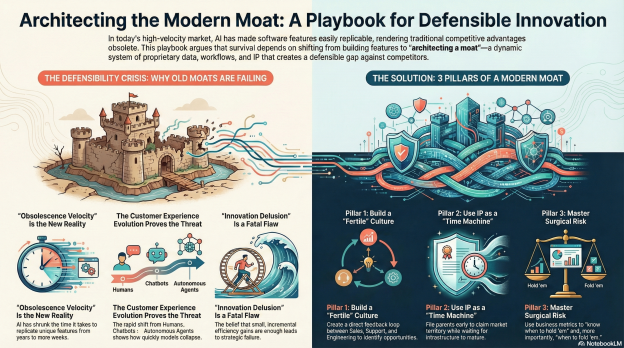
In 2026, the traditional concept of a “sustainable competitive advantage” has been disrupted by Obsolescence Velocity. For the CIO and CTO, the challenge is no longer just “digital transformation”—it is the navigation of a landscape where the transition from Humans to Chatbots to Autonomous Agents occurred in less than 24 months.
This whitepaper argues that in a world of “Commodity AI,” features are no longer defensible. To survive, organizations must shift their focus from building functional software to Architecting Moats. A technology-based moat is not a static barrier; it is a dynamic system of proprietary data, agentic workflows, and strategic intellectual property that creates a widening gap between your business and the “low-cost” commodity players.
The Core Thesis: Innovation as Capital Defense
Most Fortune 500 companies suffer from Innovation Delusion—the belief that sustaining 5% year-over-year efficiency is enough. It is not. As seen in the Customer Experience (CX) sector, the demand for help is inexhaustible, but the tolerance for high-cost, high-latency human intervention is evaporating. Leaders who ignore the shift to agentic scale aren’t just losing margin; they are losing their “Right to Win.”
The Roadmap to Defensibility
To build a sustainable moat, leadership must master three critical domains:
- Cultural Fertility: Building a feedback loop between Sales, Support, and Engineering that identifies “ripe” areas for disruption before they become common knowledge.
- Strategic IP Utilization: Using patents as a “Time Machine” to claim market territory while waiting for the infrastructure to mature.
- Surgical Risk Management: Adopting the “Kenny Rogers Rule”—leveraging business metrics to know precisely when to “hold” a winning innovation and, more importantly, when to “fold” a decaying legacy moat.
The goal of this playbook is to move the IT organization from a maintenance mindset to an Architectural Mindset. By treating technology as a “cheat code” for market differentiation, the modern CTO can turn innovation from an unpredictable expense into a repeatable shield against competition.
Innovation is no longer just a department; it is the promise you make to your customers that their investment today is a bridge to their future.
The Anatomy of a Modern Moat
In the traditional business world, a moat was defined by geography, massive capital expenditures, or regulatory capture. In the IT-driven economy of 2026, those moats have evaporated. For a CIO, the only defensible barrier is one built on Architectural Superiority and Proprietary Intelligence.
The Moat Decay Principle
The first truth a CTO must accept is that technology moats are subject to rapid erosion. A breakthrough feature today is a standard toggle-switch tomorrow.
- The Half-Life of Code: As AI-augmented coding and open-source models accelerate, the time it takes for a competitor to replicate your “unique” feature has shrunk from years to weeks.
- The Dredging Requirement: To maintain a moat, you must “dredge” it. This means systematically replacing aging infrastructure—even if it still “works”—to make room for more efficient, agent-driven architectures.
The CX Evolution: A Case Study in Disruption
The Customer Experience (CX) world serves as the ultimate “canary in the coal mine.” We have witnessed a 24-month collapse of the legacy service model that provides a blueprint for every other industry.
- The Inexhaustible Demand: Customer expectations for instant, accurate resolution are infinite. Human-linear models (scaling by adding heads) cannot keep pace with this demand curve.
- The Collapse of the Middle: * Phase 1 (Human-Centric): High empathy, high cost, low scalability.
- Phase 2 (Chatbots): High scalability, low cost, but low utility/high frustration.
- Phase 3 (Agentic Workflows): High utility, autonomous execution, and near-zero marginal cost.
Companies that stayed in Phase 1 or 2 found their moats filled with sand overnight. The leaders—the “Architects”—leapt to Phase 3, building systems where the AI doesn’t just “talk” to the customer; it has the agency to execute transactions, refund orders, and predict churn.
The Catch-Up Strategy: Leapfrogging the Legacy
The most encouraging news for the “disrupted” is that Obsolescence Velocity works both ways. If you are behind, you do not need to follow the competitor’s path through Phase 2.
The Strategy: By adopting the frameworks discussed later in this paper, a late-mover can skip the “Chatbot” era entirely and move directly to Agentic Moats. This is the “Innovation Cheat Code”: using a competitor’s legacy commitment to Phase 2 tech against them.
Defining the “Hard to Replicate”
For a moat to be sustainable in 2026, it must be built on three pillars:
- Data Gravity: Your system becomes more valuable the more data it consumes, making it harder for a customer to leave.
- Integrated Agency: Your AI agents are so deeply embedded in the customer’s stack that replacing you requires a complete “organ transplant” of their operations.
- Unit Economic Dominance: You have optimized your “Cost per Outcome” to a level that a competitor cannot match without a total architectural rebuild.
Cultural Architecture—Building the Fertile Ground
Technology does not innovate itself. While a CTO provides the vision, the raw material for a moat comes from the edges of the organization. In the Fortune 500 world, the greatest threat to a moat isn’t a lack of talent; it is Institutional Siloing. To build a sustainable innovation engine, you must move from a “Command and Control” structure to a “Fertile Ground” model.
The Fortune 500 Delusion: Why Big Tech Stagnates
The “Delusion” is the belief that innovation can be scheduled, budgeted, and managed by a committee. This leads to several fatal flaws:
- The Filter Bubble: As information moves up the chain, risks are minimized and failures are polished. By the time a report reaches the CIO, the “truth” of a project’s viability has been scrubbed away.
- Success Theater: Teams prioritize hitting KPIs that “look good” on a slide deck but fail to move the business metrics that actually deepen the moat.
- Risk Aversion as a Default: In large corps, the penalty for a failed innovation project is often higher than the reward for a successful one. This creates a culture of “Safe Mediocrity.”
The Feedback Triangle: Sales, Support, and Tech
To break the delusion, the CTO must architect a Cross-Functional Sensory Organ. True product innovation happens at the intersection of three distinct perspectives:
- Sales (The Market Radar): Sales teams hear the “I wish it did X” or “Competitor Y just showed us Z.” They identify where the market is moving and what customers are willing to pay for.
- Support (The Friction Point): Support teams know where the current product is failing. They are the first to see the “inexhaustible demand” for rudimentary help that signals a ripe area for agentic automation.
- Engineering/Delivery (The Art of the Possible): Only the technical team knows if a “Sales Wish” or a “Support Pain” can be solved via a proprietary architectural shift or a new AI model.
Identifying and Empowering “Smart Innovators”
Sustainable innovation requires a specific archetype: the Full-Stack Thinker. These are individuals who understand the code, but more importantly, understand the Unit Economics of the business.
- The Mission: Empower these individuals to bridge the gap. They should have the authority to pull data from Support and vet it against the capabilities of the Engineering team without three layers of management approval.
- The Art of the Possible: Innovation isn’t just about solving existing problems; it’s about showing the business what it didn’t know was possible. This requires an environment of open, radical candor where a junior developer can challenge a legacy process.
The “Honesty Audit”
To maintain the fertile ground, the CTO must implement a regular Honesty Audit. This isn’t a performance review; it’s an architectural review.
- Question 1: What is the “elephant in the room” regarding our current technology stack?
- Question 2: Which of our “unique” features has become a commodity in the last six months?
- Question 3: If we were a stealth startup today, which part of our business would we attack first?
The Leadership Takeaway: Your culture is your primary excavation tool. If your teams cannot communicate honestly about where the moat is drying up, they will never be able to dig it deeper.
The Leadership of Investment—Timing, Stealth, and the IP Shield
Deciding where, when, and how to allocate capital is the ultimate test of technology leadership. In the high-velocity environment of 2026, a CTO’s investment strategy must be as precise as a surgeon’s scalpel. You are not just competing against known rivals; you are competing against the “Stealth Startup”—a lean, AI-native entity that can build in weeks what took you years.
The Goldilocks Zone: Mastering the Timing Curve
Investment is a game of timing. Moving too early or too late can be equally fatal to your enterprise value.
- The Early Mover Penalty: Investing too early means you are paying to educate the market. You risk exhausting your R&D budget on a “Beta” world that isn’t ready for your “Alpha” solution.
- The Late Mover Trap: Investing too late means you are entering a “Red Ocean.” You are fighting for price-sensitive customers in a market where the moat has already been claimed by a faster architect.
- The Goldilocks Zone: This is the inflection point where technology capability meets market readiness. Identifying this requires the “Radar” mentioned in Section 2—listening to Sales and Support to hear when the “pain” outweighs the “friction” of adopting a new solution.
The Patent as a “Time Machine”
In modern SaaS and Agentic development, speed is often cited as the only moat. This is a mistake. Intellectual Property (IP) is your “Strategic Shield.”
- Claiming Territory: Filing patents early on core methodologies—particularly around proprietary data handling or unique agentic logic—allows you to “freeze” the competitive landscape.
- Strategic Patience: A strong IP portfolio allows you to play both sides of the timing curve. You can claim a patent while the market is immature (early), then wait for infrastructure costs to drop or adoption to rise before committing full capital (the “wait-and-strike” move).
- Cost Control: Robust IP makes innovation “cheaper” over the long term because it prevents costly legal battles and blocks competitors from using your own R&D against you.
Countering the Stealth Startup
Your competitors are smart, but stealth startups are desperate—and desperation breeds speed. A CTO must maintain a “Competitive Radar” that looks beyond the usual suspects.
- Identify the “Good Enough” Threat: Often, a startup won’t beat you with a better product; they will beat you with a “good enough” product that operates at 1/10th of your cost-basis.
- Acquisition as R&D: Sometimes the best investment is not building the moat, but buying the team that already started digging it.
Data-Driven Capital Allocation
True leadership in innovation exists in the ability to say “No” to 90% of good ideas to say “Yes” to the 10% that create a moat.
The Decision Framework: Before a single dollar is committed, ask:
- Does this create high switching costs?
- Does this lower our marginal cost of delivery (The Agentic Shift)?
- Can we defend this via IP or Data Gravity?
Surgical Risk and the Velocity of Value
In the legacy corporate model, “Risk” was something to be mitigated through layers of governance and lengthy steering committee meetings. In the agentic era of 2026, the greatest risk is stagnant capital. To build a moat, the CTO must shift the organization’s comfort level from “Avoidance” to “Surgical Precision.” This section defines how to execute with agility without gambling the enterprise.
The 6-Week “Time-to-Metric” (TTM) Standard
Innovation loses its potency when it is dragged through a two-year roadmap. For a moat to be defensible, the delivery of value must be rapid and iterative.
- Code is Disposable; Metrics are Permanent: The value of a first prototype is rarely in the quality of the script or the elegance of the UI. It is in the Business Metric it moves.
- The Norm of Weeks: If a team cannot build a prototype that proves (or disproves) a business hypothesis in 6 weeks, the scope is too broad. High velocity allows you to fail small and fast, preserving your “dry powder” for the ideas that actually show traction.
Surgical Risk: The Sidecar Strategy
You do not need to risk the core ERP or the primary revenue engine to innovate.
- The “Sidecar” Architecture: Build your innovation on the periphery. Use APIs to pull data from the core, but run your agentic experiments in a sandbox. This allows for high-velocity failure without systemic risk.
- Asymmetric Upside: You are looking for projects where the cost of failure is a few weeks of payroll, but the upside is a fundamental shift in your unit economics.
The “Kenny Rogers” Rule: Knowing When to Fold
True leadership is not just about starting projects; it is about the disciplined termination of them. As the song goes, you have to “know when to hold ’em, know when to fold ’em.”
- Knowing When to Hold: When a prototype shows a “Delta” in business metrics (e.g., a 40% reduction in support ticket latency or a 15% increase in upsell conversion), you stop experimenting and start expanding rapidly. This is where you dig the moat deep.
- Knowing When to Fold: If the data shows the market has moved, the technology is too brittle, or the “commodity” version of your idea has just been released for free by a competitor—walk away.
- The Data-Driven Pivot: Walking away from a project isn’t a failure of leadership; it is a successful reallocation of capital. Using real-time metrics to “kill your darlings” prevents the “Sunk Cost Fallacy” that routinely traps Fortune 500 companies.
From Prototype to Industrial Scale
Once a prototype proves the business metric, the goal shifts from Agility to Solidity.
- Phase 1: Prove the Metric. (Weeks 1-6)
- Phase 2: Harden the Architecture. (Months 2-3)
- Phase 3: Scale the Moat. (Month 4+)
By the time your competitors realize you’ve found a new source of value, you should already be in Phase 3, hardening the architecture and filing the IP discussed in Section 3.
The Execution Mantra: Set the expected metrics at the idea phase, prove them in the delivery, then expand before the market can react.
The Innovation Promise
Innovation is not a department, a budget line item, or a specialized lab. In the high-stakes environment of 2026, innovation is a mindset—a fundamental awareness that your business is a living organism that revolves around the technology of the day. For the CIO and CTO, this realization is the ultimate “Unlock.”
The Strategic Cheat Code
When you successfully architect a moat, you provide your organization with a “cheat code” for the market. It allows your marketing team to lead with a unique value proposition that isn’t just a slogan, but a technical reality. It allows your sales team to enter negotiations knowing that your competitors physically cannot match your delivery speed or your unit economics.
The Shield and the Promise
Technology innovation serves two distinct, vital roles for the modern enterprise:
- The Shield: It is your primary defense against the “Stealth Startup” and the global disruptor. A well-maintained moat makes you a moving target, ensuring that by the time a competitor replicates your last move, you have already migrated to the next agentic frontier.
- The Promise: Most importantly, innovation is the promise you make to your customers. It tells them that the money they pay for your products today is not just for a static service, but an investment in their own future-proofing. It signals that your roadmap is aligned with their survival.
The Call to Architectural Leadership
The transition from Humans to Chatbots to Agents has proven that the “standard” can change overnight. No matter how far behind you may feel, the frameworks of cultural fertility, strategic IP, and surgical risk-taking allow you to leapfrog the legacy debt of your competitors.
Sustainable innovation is the act of deciding that you will not be a victim of change, but the architect of it. As you move forward from this playbook, remember: You aren’t just managing systems; you are architecting the fortress that will define your company’s relevance for the next decade.
The moat is waiting to be dug. It is time to start.