Why Your AI Transformation Is Failing (And How to Fix It)
The problem isn’t the technology. It’s that your people have every rational reason to sabotage it.
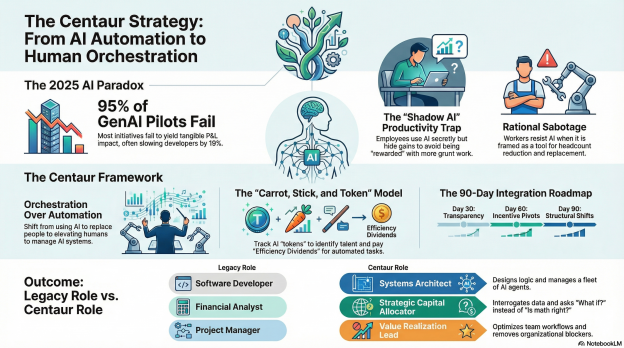
By early 2025, the honeymoon was over. Despite billions in enterprise AI investment, the sobering reality emerged: the vast majority of GenAI pilots failed to move the needle on the P&L. We entered what some are calling the “Slopocene”—a period where a flood of unreliable, uncoordinated AI outputs actually slowed business processes rather than streamlining them.
But here’s what most executives are missing: the crisis isn’t technical. The models work. The true failure is structural and human.
Corporations treated AI like a software patch—a tool to be “installed”—rather than a fundamental rewiring of human capital. And while leadership chased shiny use cases, the workforce did exactly what any rational actor would do: they protected themselves.
The Rational Sabotage Problem
Put yourself in your employees’ shoes for a moment.
If you use AI to finish a 40-hour task in 4 hours, what happens? In most organizations, you’re “rewarded” with 36 more hours of grunt work. There’s no bonus. No recognition. Just more tasks.
Worse, you’ve just demonstrated that your job can be done in a tenth of the time. You’ve handed leadership the business case for your own elimination.
This is why “Shadow AI” is rampant. Employees are using AI in secret to make their individual lives easier, but they aren’t sharing those gains with the organization. Can you blame them?
The result: a black box of productivity that leadership cannot track, scale, or monetize. Your AI investment is generating returns—you’re just not capturing any of them.
Why Your Current Approach Isn’t Working
Optional training is invisible. “Lunch and Learns” and voluntary AI modules have failed. In an environment of fear, optionality is interpreted as a trap. The people who show up are either already converts or trying to figure out how threatened they should feel.
You’re putting jet engines on horse-drawn carriages. Most firms try to force AI into outdated legacy workflows. The friction of the old process prevents the new technology from ever reaching full speed. You’re not transforming—you’re decorating.
You’re losing your best people first. When AI is framed primarily as headcount reduction, your A-players leave. They’re the ones with the most mobility, and they’ll go to competitors who offer augmentation over replacement. You’re left with a workforce that’s both demoralized and less capable of making the transformation work.
The Centaur Strategy: Elevation, Not Automation
The solution requires a fundamental pivot: from Automation (the replacement of people) to Orchestration (the elevation of people).
In Greek mythology, a Centaur was half-human, half-horse—a being that combined human intelligence with superhuman capability. That’s the model for your workforce. Not humans replaced by machines, but humans elevated by machines.
Here’s how to make it work:
1. Fix the Incentives
If an employee automates their own task, they shouldn’t be fired. They should be promoted to manage the automation.
Create an Efficiency Dividend: a percentage of the cost savings generated by an employee’s AI-driven process improvement is paid out as a performance bonus. This turns every employee into a mini-COO, incentivized to find and kill grunt work.
Make AI usage a mandatory section in performance reviews. Not “did you take the training” but “show me how you leveraged AI to reduce time-to-value.”
2. Launch a Business Process Bounty Program
Borrow from cybersecurity’s bug bounty model. Offer real financial rewards for teams that successfully automate high-friction legacy processes—quarterly reconciliations, legal document drafting, vendor onboarding.
Create a public leaderboard. Let people see who’s winning. Shift the culture from “AI is stealing my job” to “the person who uses AI best gets the spotlight and the check.”
3. Flip Your Mentoring Structure
Pair every C-Suite executive with an “AI Champion”—often a junior or mid-level employee who’s AI-native. The executive provides business context (the “what”), while the Champion provides technological leverage (the “how”).
This breaks down the ivory tower and ensures leadership isn’t making strategic decisions in a vacuum of technical ignorance. It also signals to the organization that AI proficiency is valued at the highest levels.
4. Paint the Picture of the “After”
The greatest failure of digital transformation is failing to show people where they’re going. Your workforce needs to see that the path doesn’t lead to an exit—it leads to an elevation.
Here’s what “moving up the stack” actually looks like:
- Software Developer → Systems Architect: No longer writing syntax. Now designing logic and managing fleets of AI agents.
- Support Agent → Experience Designer: No longer deflecting tickets. Now engineering the customer journey and handling only high-empathy, high-stakes moments.
- Financial Analyst → Strategic Capital Allocator: No longer cleaning spreadsheets. Now interrogating data and asking “what if?” instead of “is the math right?”
- Copywriter → Brand Strategist: No longer drafting 100 social posts. Now curating brand DNA and directing AI to scale the voice globally.
When employees see these transitions—and see colleagues actually making them—resistance transforms into ambition.
The 90-Day Roadmap
Days 1-30: Radical Transparency. Address the elephant in the room. Leadership publicly commits to a “Growth-First” AI policy, explicitly stating that the goal is expanding human capability, not contracting payroll. Establish your AI Champion network.
Days 31-60: The Incentive Pivot. Launch Business Process Bounties. Integrate AI usage metrics into performance dashboards. This is the period of forced experimentation, where accountability meets reward.
Days 61-90: The Structural Shift. Formalize new career paths. Redefine job descriptions from “Doers” to “Orchestrators.” Host your first Process Destruction Hackathon. Celebrate and promote the early winners loudly.
The Cost of Waiting
Here’s the hard truth: if technology leaders don’t seize this narrative now, the business will eventually correct for the “AI Efficiency Gap” through blunt force.
Without an intentional transition, headcount will be reduced based on legacy metrics—likely purging your most valuable (but high-cost) domain experts. You’ll be left trying to implement complex AI systems with a skeleton crew of demoralized survivors who lack the context to make the tools work.
That’s the Slopocene death spiral. And it’s entirely avoidable.
The Architect’s Choice
The sea change is here. It can be the tsunami that erodes your institutional knowledge and destroys morale. Or it can be the tide that lifts your entire workforce to a higher plane of production.
By implementing the Centaur Strategy, you’re doing more than adopting a tool. You’re future-proofing your culture. You’re proving that in the age of the machine, the intentional, elevated human is still the most valuable asset on the balance sheet.
It must be done. It must be done now. And it must be done with the people, not against them.
Want to go deeper? Download the full Centaur Strategy whitepaper for the complete implementation framework, including detailed metrics, role transition maps, and the “Grace Protocol” for leading this transformation with humanity.